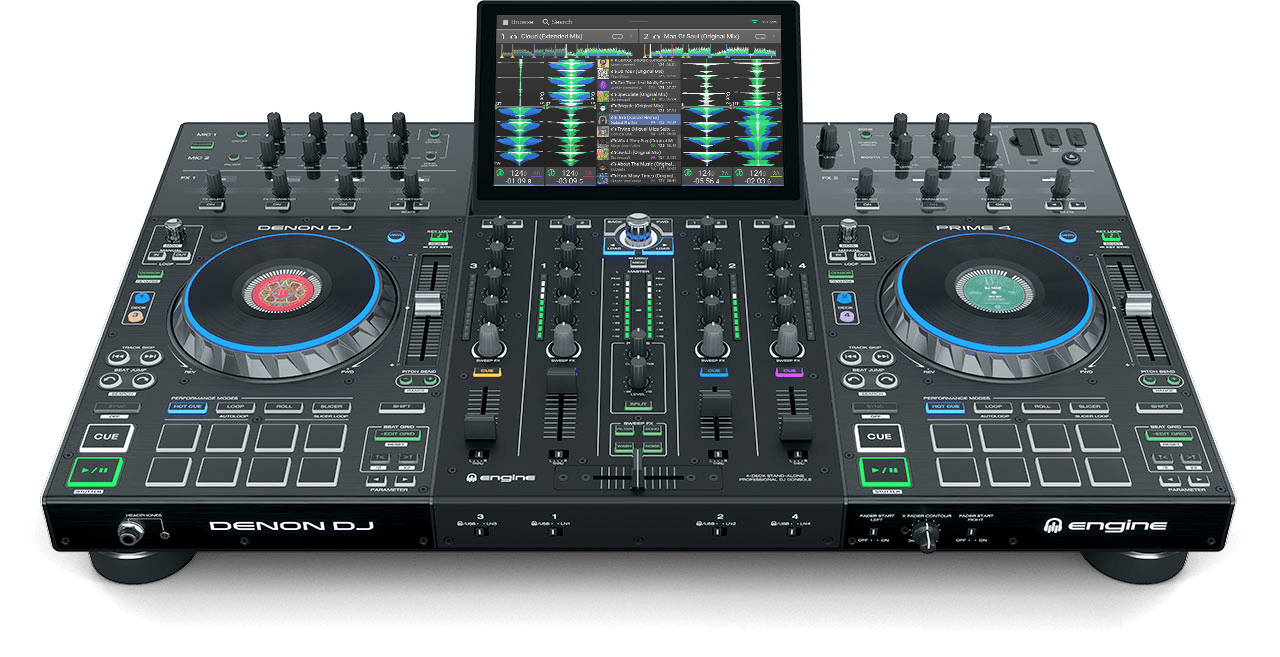
PRIME 4 arrived with an unusually ambitious interpretation of the standalone DJ system. Rather than treating all-in-one hardware as a simplified two-deck alternative to a club setup, Denon DJ built a four-channel mixer, four-deck software architecture and large touchscreen into one chassis. Years later, that basic proposition still makes sense.
The 10.1-inch multi-gesture touchscreen can show four-deck waveforms, browse libraries and manage playlists without a laptop. Media support is broad: four USB inputs, SD storage and an internal 2.5-inch SATA drive bay. For DJs carrying large local libraries, the option to install storage inside the unit remains particularly useful.
Four physical mixer channels pair with deck-layer controls on the two jog sections. Performance pads handle hot cues, rolls, slicer and looping, while dedicated FX controls keep the main effects away from touchscreen-only operation. Serato DJ Pro and VirtualDJ controller modes are available when a laptop workflow is required.
The routing is where PRIME 4 still separates itself. The Zone output can send a different playlist to a second room with its own level and EQ. That is a practical feature for mobile work, bars and multi-room events rather than a headline designed for a specification sheet. Two microphone inputs with dedicated controls reinforce the same professional-event focus.
Networking through built-in Wi-Fi and Ethernet connects Engine DJ to supported streaming services and cloud sources. StagelinQ integration can also communicate with lighting and video systems such as SoundSwitch and Resolume.
There are reasons to look at newer hardware. PRIME 4 is large, heavy and based on an earlier generation of processing. The jog layout and layered deck approach also feel different from four physical club players. None of that erases the original design’s breadth. For the right job, especially where standalone routing matters as much as mixing, PRIME 4 remains an unusually complete machine.