
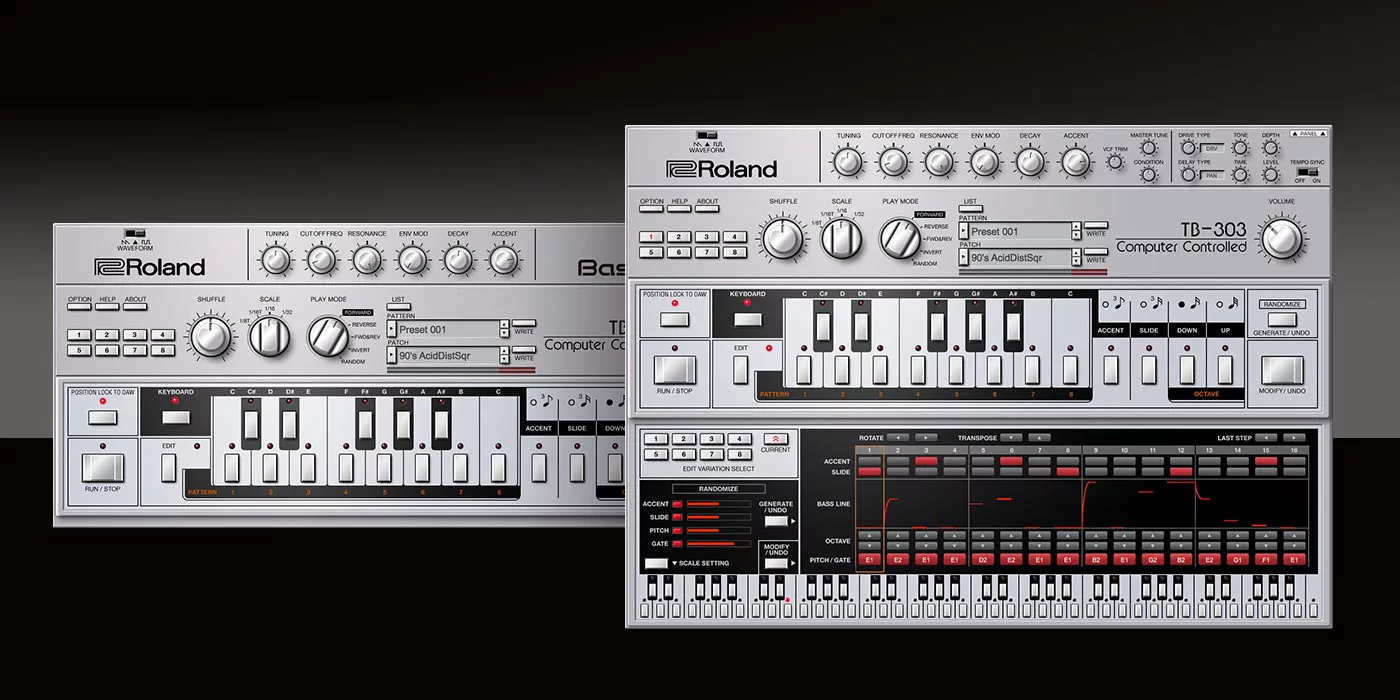
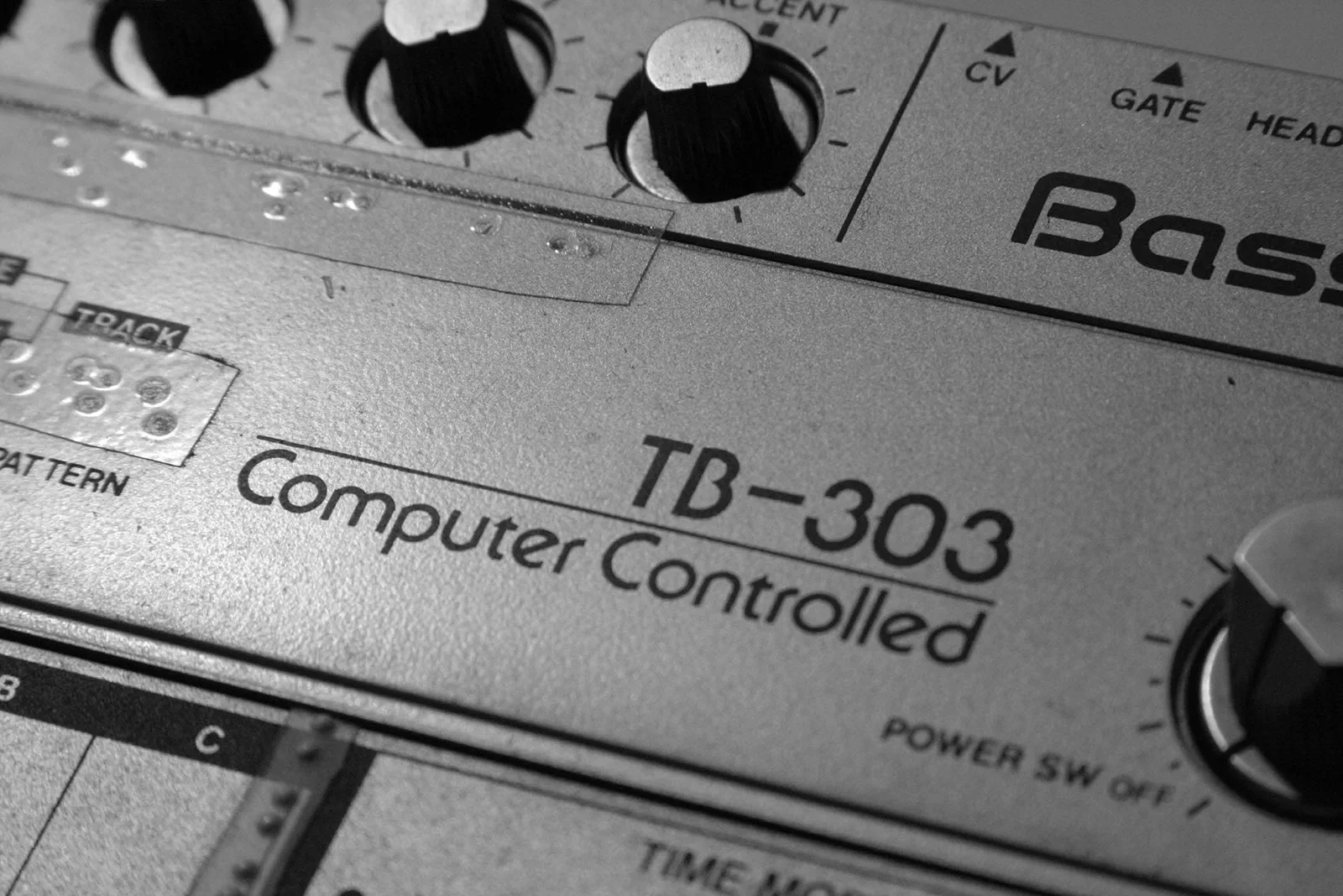
The Roland TB-303 Bass Line entered the market in 1981 with a practical job. Tadao Kikumoto and Roland’s engineering team designed it as a portable, programmable bass accompaniment for musicians who did not have a bassist in the room. Paired with the TR-606 through DIN Sync, it could form a compact backing section: drums from one silver box, bass from the other. On paper, the idea made sense. In practice, the 303 was an awkward substitute for an electric bass, sold poorly and disappeared from Roland’s catalogue after a short production run.
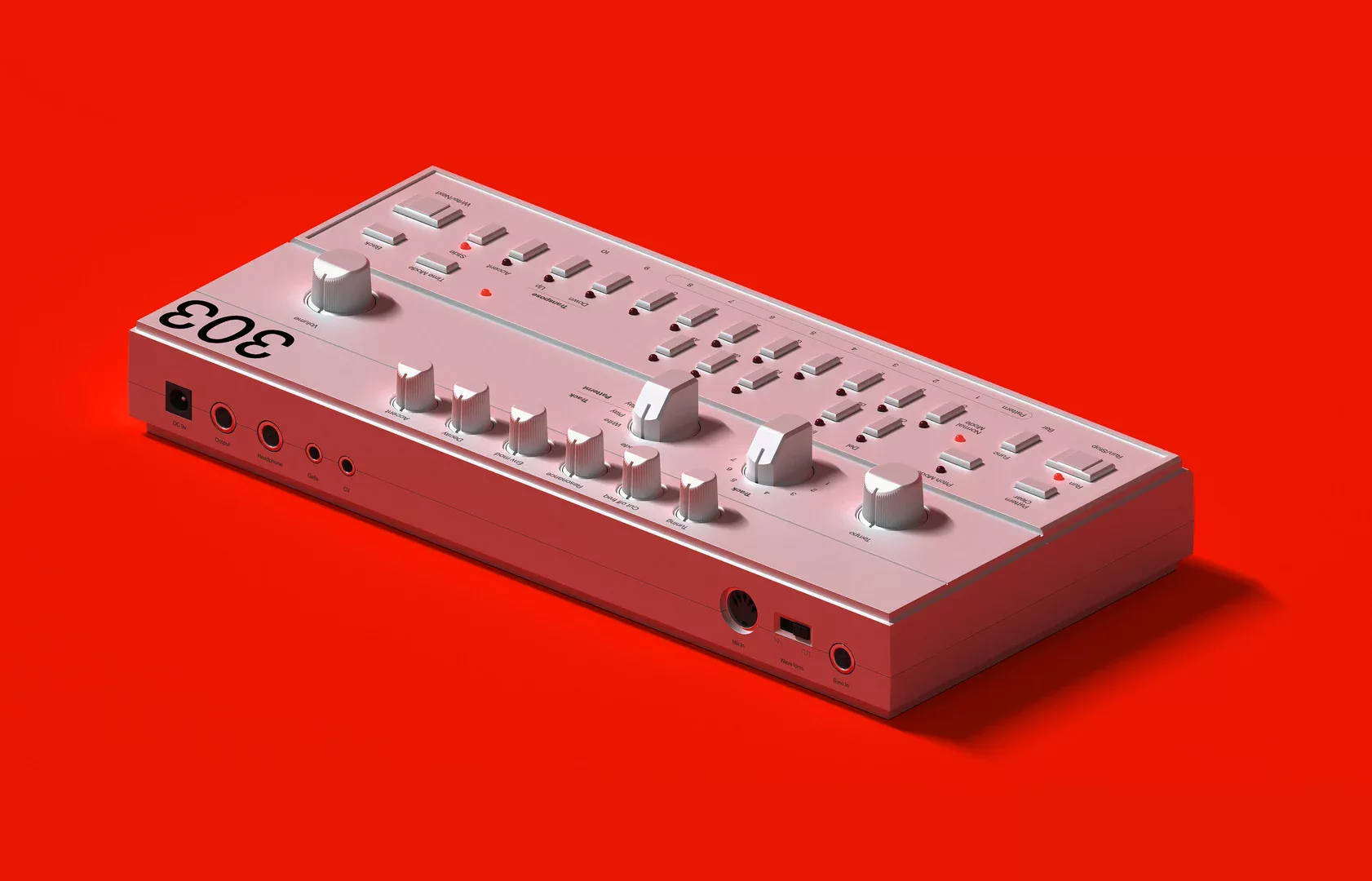
The story that followed has become so familiar that it is easy to flatten it into mythology: failed machine, pawn shop, Chicago, acid house. The interesting part sits inside the details. The TB-303 did not accidentally contain a preset called “acid”. Its sound became a language because musicians discovered relationships between the sequencer, accent, slide, filter and real-time control that Roland had not designed as a genre. The machine supplied the constraints. Chicago producers supplied the method.
That distinction matters. Electronic instruments often become historically important because artists use them against their intended purpose. The TB-303 is one of the clearest cases. A device built to impersonate a conventional instrument ended up producing a timbre that resembled almost nothing acoustic. Its commercial weakness helped place units into second-hand shops at affordable prices. Its programming method frustrated users who wanted normal basslines. Those same conditions gave another community room to discover something stranger.
- Released: 1981
- Designer: Tadao Kikumoto / Roland
- Original purpose: programmable bass accompaniment
- Companion instrument: TR-606 Drumatix via DIN Sync
- Architecture: monophonic analogue synthesizer with saw and square waveforms
- Filter: resonant -18 dB/octave ladder low-pass design
- Key performance parameters: cutoff, resonance, envelope modulation, decay, accent and slide
- Original production: around 10,000 units according to Roland
A bass machine designed around accompaniment
The initials tell the original story: TB meant Transistor Bass. Roland imagined the 303 as part of a compact automated rhythm section, especially for solo performers, guitarists and musicians practising without a full band. The TR-606 could provide drums, the TB-303 could provide a programmed bass part, and DIN Sync kept both machines running together.
The concept belongs to a specific moment in electronic-instrument design. Affordable digital sequencing was still emerging, MIDI had not yet standardised communication between instruments, and a small battery-powered bass machine offered real practical value. The 303’s mini keyboard made pitch entry look familiar, while its step sequencer could store note information and timing separately. A musician could chain patterns into longer tracks and create an accompaniment without playing the line in real time.
The weakness was musical realism. An electric bass is full of microdynamics: finger attack, string noise, note length, muting, slides, inconsistent velocity and the physical relationship between consecutive notes. The 303 offered a single oscillator, a fixed signal path and a highly stylised envelope. It could make a bass-like pitch sequence, but its tone and articulation had a synthetic identity that became more obvious the harder users pushed the controls.
One oscillator, two waveforms and a filter that became a performance control
The 303’s synthesis architecture is compact. A single voltage-controlled oscillator produces either sawtooth or square wave. The saw has more upper harmonic content and tends to cut aggressively through a mix; the square is rounder and can produce a deeper fundamental character when the filter is kept lower. From there, the signal enters the resonant low-pass filter that became central to the instrument’s identity.
Roland describes the original filter as an -18 dB-per-octave ladder design. That slope is part of the reason the TB-303 responds so distinctively to resonance. Raising resonance emphasises frequencies around the cutoff point; moving cutoff then shifts that concentration of energy through the harmonic spectrum. With a repetitive sequence underneath, the ear hears the same notes repeatedly changing colour. A static line starts to feel as though it is moving.
This is where the original bass-accompaniment concept begins to break apart. A player imitating an electric bass might choose a sensible tone and leave it largely alone. Acid performance turns the same controls into an instrument. Cutoff is swept by hand. Resonance rises until the filter becomes nasal, sharp or almost vocal. Envelope modulation changes how strongly each note pushes through the filter. Decay alters how long that motion hangs around. The pattern remains recognisable while its timbre is continuously rewritten.
Envelope modulation and decay: why one pattern can stay alive for minutes
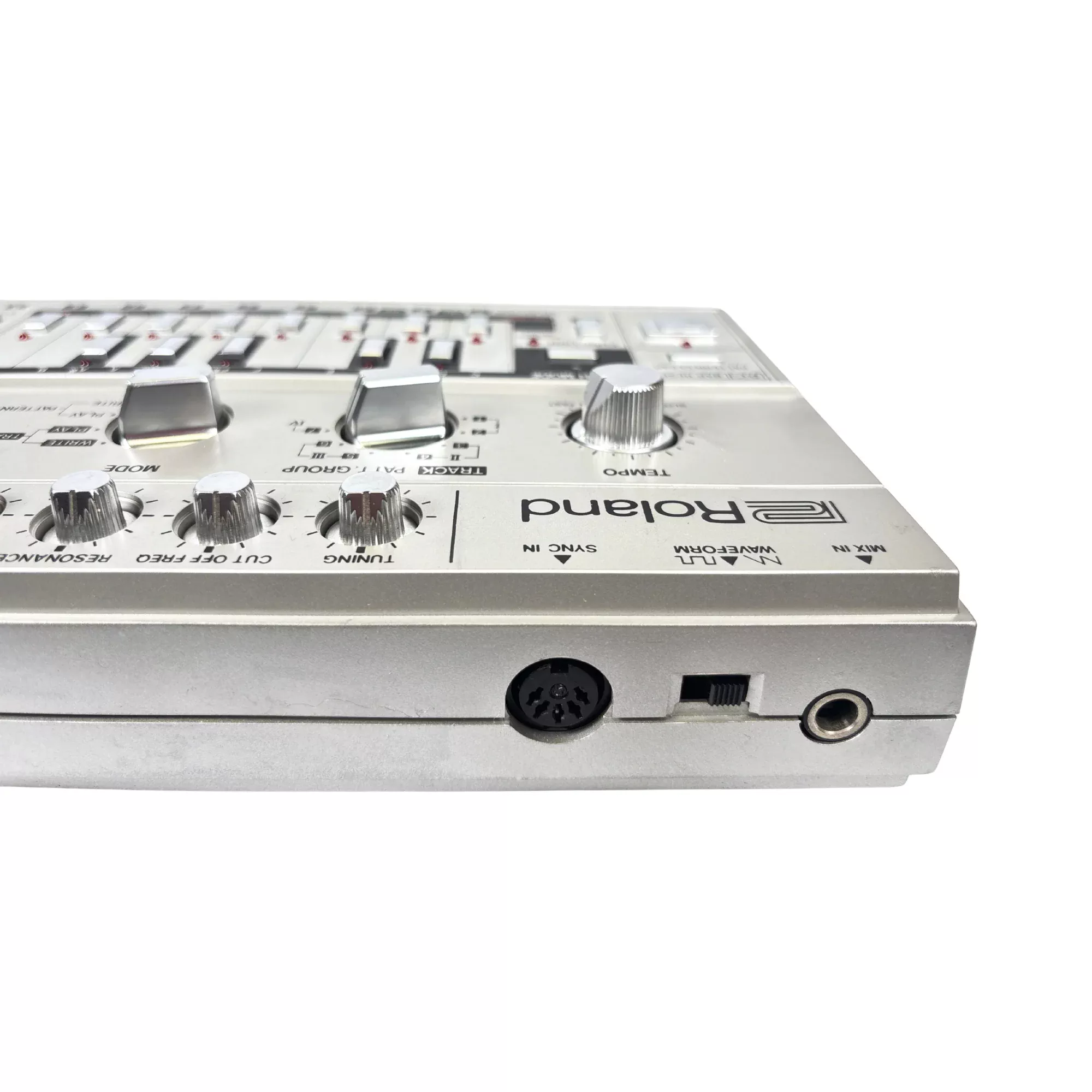
The TB-303 has very little conventional modulation compared with a modern synthesizer. There is no modulation matrix and no bank of freely assignable LFOs. Its expressive power comes from a small number of strongly coupled behaviours. Envelope Mod determines how much the filter envelope affects cutoff. Decay determines how long that envelope takes to fall. When the cutoff and resonance are already near sensitive points, tiny changes in either control can produce a large perceptual shift.
This is a major reason acid can sustain long arrangements around a short sequence. A sixteen-step pattern does not need new notes every eight bars if the spectral shape keeps changing. Opening the cutoff reveals more harmonics. Increasing resonance narrows attention around the moving cutoff point. Reducing decay can turn a liquid phrase into something percussive; extending it lets notes smear into one another. The musical development happens in timbre rather than harmony.
That idea later became routine across techno and house: the loop stays fixed while the filter becomes the arrangement. On the 303, the relationship is unusually direct because the machine gives the performer so few places to hide. There are no pages of parameters to automate. The controls that matter are physically exposed, close together and responsive enough to be played continuously.
Accent is not simply velocity
One of the most misunderstood parts of the 303 is accent. On many sequencers, velocity means louder or softer. The TB-303’s accent behaviour is more structural. Accented steps increase level and interact with the filter response, so emphasis changes both amplitude and tone. The Accent knob controls the strength of that behaviour across the pattern.
A sequence without accents can feel flat even if the pitches are interesting. Add accents selectively and a hierarchy appears. Certain steps push forward, the filter reacts differently and the bassline starts to lean against the drums. Because the accent is stored per step, it becomes rhythmic information. The pattern gains internal dynamics without needing multiple oscillators or complex automation.
This interaction is one reason exact 303 emulation is harder than reproducing a saw wave and a resonant filter. The character lives in how the subsystems respond together. Roland’s later ACB recreations repeatedly emphasise the need to model accent, slide and sequencer behaviour alongside the oscillator and filter. A clone can sound broadly correct in a sustained note and still feel wrong once a pattern starts moving.
Slide turns discrete steps into a continuous phrase
Slide provides the other defining articulation. The sequencer can tie adjacent pitches so that one glides into the next rather than restarting as a separate note. Used sparingly, this makes a rigid step sequence feel elastic. A high note can smear down into the following bass note; an octave jump can become a fast sweep; a short pattern can acquire a sense of breath and tension that would be difficult to predict by looking at the step data alone.
The liquid quality associated with acid comes from the combination of slide and filter movement as much as from resonance itself. A resonant filter sweep on static notes can sound electronic and dramatic, but the characteristic 303 phrase often depends on pitches bending through that moving spectrum. The note transition and the timbral transition happen at the same time.
This behaviour also undermines the original idea of a neutral backing bassist. Slide on an electric bass has a physical reference; on the 303 it can be exaggerated, repeated and sequenced with machine precision. The instrument moves away from imitation and towards its own grammar.
The sequencer’s awkwardness became part of the creative method
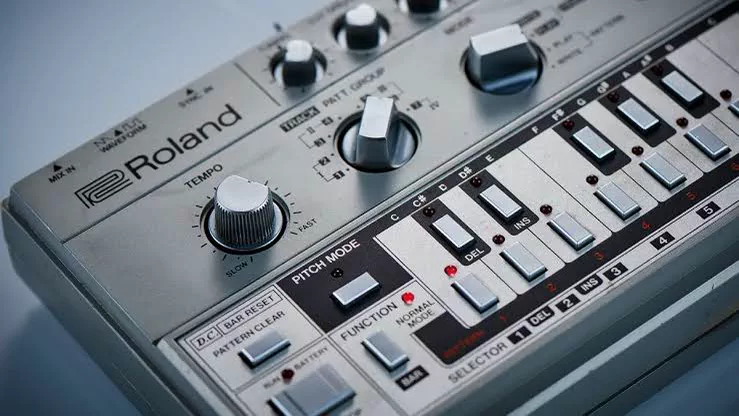
The original sequencer is famous for being difficult to programme. Pitch and timing are entered through separate procedures, and the small interface gives limited visual feedback. From a modern perspective, where a piano roll shows every note and step immediately, the 303 can feel deliberately obscure. That obscurity was initially a usability problem. It later became part of the instrument’s creative mythology because users often ended up with patterns they had not consciously imagined.
Accidents matter in electronic music when they remain editable enough to become decisions. A strange pitch sequence, unexpected rest or misplaced slide can be rejected, or it can become the thing around which the entire track is built. Producers who learned the 303 without a manual frequently describe the process in those terms: trial, error, listening and selective acceptance.
Josh Wink’s recollection is particularly revealing. He bought his first TB-303 from a Philadelphia pawn shop in 1990 for $70 and had no manual. He later described some of his favourite lines as the result of mistakes made while figuring out the machine. The important point is not romantic incompetence. It is that the interface did not always translate intention directly into result, leaving space for discovery.
Technical point: the 303’s limitations are interconnected. A single oscillator reduces harmonic complexity at the source; the resonant filter becomes disproportionately important; accent alters dynamics and filter behaviour; slide changes pitch continuity; the sequencer encourages repetition. Acid emerged from musicians treating those constraints as a performance system rather than trying to make the machine behave like a conventional bass instrument.
Commercial failure changed who could afford the machine
Roland discontinued the TB-303 after a relatively short run, with the company now estimating that roughly 10,000 original units were produced. The failure matters because it changed the instrument’s economics. A new synthesizer marketed as professional equipment has one audience. An unwanted second-hand box sitting cheaply in a pawn shop has another.
By the middle of the 1980s, 303s could be found in second-hand shops at prices accessible to young producers working outside major studios. That does not mean every unit became cheap everywhere, or that the machine instantly flooded Chicago. It does mean its market value temporarily disconnected from the technological possibilities hidden inside it.
Electronic-music history contains several similar inversions. Instruments designed for one market fail, depreciate, then become available to communities that use them differently. The creative breakthrough is partly musical and partly economic. Phuture did not receive a 303 because Roland had identified acid house as an emerging genre. They encountered a discarded technology whose first market had already judged it.
Phuture found the sound by moving the controls
The central Chicago story begins with Earl “Spanky” Smith Jr., Nathaniel Pierre Jones — DJ Pierre — and Herbert “Herb J” Jackson. Spanky picked up a second-hand TB-303, and the group began experimenting with it. Roland’s account describes an instrument that initially confused them. Once they had a basic sequence running, Pierre started turning the frequency and resonance controls while the pattern played.
The discovery was behavioural. The line did not become acid because one patch had been selected. It became acid because the sound was manipulated over time. A resonant filter moved across a repeating sequence while accent, slide and the pattern itself shaped how each note reacted. The loop stopped functioning as a backing bassline and became something closer to a continuously changing texture with pitch.
That session produced a long piece first known as “In Your Mind”. Its length and repetition were important. The 303 could hold the listener inside the same sequence while manual control created gradual change. Rather than writing conventional verse-and-chorus sections, Phuture could treat timbre as the main dramatic material.
Ron Hardy turned a studio discovery into a club language
A machine and a studio session still do not create a scene by themselves. The next decisive component was Ron Hardy at Chicago’s Music Box. Hardy received a cassette of the Phuture track before its official release. Roland’s account, based on DJ Pierre’s recollections, describes an initial play that emptied the floor. Hardy did not abandon it. He returned to the track several times during the same set, and the audience gradually responded.
That detail is one of the most important parts of the 303 story because it shows how musical language can be learned socially. The track sounded alien because the conventions around it were not established. Repetition inside the DJ set gave the audience another chance to understand what the record was asking them to do. A sound that initially disrupted the room became one the room wanted again.
The cassette circulated, sometimes incorrectly attributed to Hardy, and the track built a reputation before its proper commercial release. Phuture later rerecorded it with Marshall Jefferson and issued “Acid Tracks” through Trax Records in 1987. By then, the core vocabulary was already established in the club: the 303 line as protagonist, extended repetition, evolving filter movement and a physical relationship between machine timbre and dancefloor endurance.
Why “Acid Tracks” sounded radically different
The 303 was not the only synthesizer capable of resonance, glides or sequencing. Its importance comes from the way those functions converge. A short pattern repeats with machine accuracy. Slide destabilises the boundary between notes. Accent creates internal rhythmic stress. The -18 dB/octave filter leaves enough harmonic material moving around the cutoff for resonance sweeps to remain vivid. Manual control turns the fixed pattern into a performance.
“Acid Tracks” uses that convergence over an extended duration. The interest comes from hearing the same underlying logic mutate rather than from waiting for a new chord progression. In production terms, this redistributes attention. A parameter change that might be a small automation detail in another track becomes the central musical event.
That is also why acid proved portable across different scenes. Once producers understood the method, they could place the 303 against different drums, tempos and arrangements without losing the identity. The instrument could sit inside house, techno, breakbeat, trance or later harder styles because the defining gesture was timbral and rhythmic rather than tied to one chord vocabulary.
From Chicago to the UK and Europe
By 1987 and 1988, the 303 sound had moved far beyond Chicago. Roland’s own historical material connects its spread with the UK acid-house explosion and the Second Summer of Love. The important shift was scale. What had developed around a small number of Chicago records became a recognisable sonic code for warehouse parties, clubs and raves across Europe.
The 303 travelled well because it was immediately identifiable in poor acoustic conditions. A resonant line could cut through a dense mix and remain legible on large systems. Producers could also push the machine harder with external distortion, overdrive, delay and compression. The original unit on its own can sound comparatively restrained; much of the aggressive acid associated with later records comes from what happens after the output leaves the 303.
That point is worth stressing because decades of acid production have changed the public memory of the instrument. The stock TB-303 is capable of warmth, round bass and subtle movement. The screaming, corrosive version usually involves resonance at extreme settings and often external processing. The culture built around the machine expanded its sound far beyond the original circuit operating in isolation.
Hardfloor turned the conversation into two voices
By the early 1990s, acid had moved from discovery into refinement. Hardfloor’s “Acperience 1” is one of the clearest examples of producers treating the 303 as an established instrument with its own advanced performance vocabulary. Roland still uses the track as a reference when explaining acid programming today.
The technical interest lies in interaction. Once multiple 303-style lines operate together, each needs its own register, rhythm and spectral movement. One can hold a lower repetitive figure while another behaves almost like a lead. Filter sweeps can answer each other. Slides can create contrary motion. Resonance can be balanced so that the lines remain distinct instead of collapsing into the same frequency range.
This is where acid starts to resemble counterpoint built from timbre. Traditional harmony still matters, but much of the drama comes from the relationship between patterns and filters. The 303 has become a voice whose articulation is understood well enough for producers to write conversations between several instances.
Josh Wink pushed resonance towards the mastering limit
Josh Wink’s “Higher State of Consciousness” shows another direction. Wink has said he used two original stock TB-303s on the track, combining their lines with a nervous breakbeat structure. The famous “Tweekin’ Acid Funk” version drives the upper-frequency energy to a point that became a mastering concern.
Wink recalled that the label asked him to revise the mix because the high-frequency crescendo seemed too extreme for the mastering plant to cut safely. He refused because reducing it would change the musical idea. That anecdote captures how far the 303 had moved from its original purpose. A machine intended to sit politely underneath a performer was now being used to push a vinyl master towards its physical limits.
The track also demonstrates that acid did not depend on four-to-the-floor house. Breakbeats, sampled vocals and 303 sequences could coexist without weakening the identity. The sound had become a transferable production language rather than a narrow subgenre formula.
The distortion myth and what the original actually sounds like
Later acid often sounds more distorted than the machine itself. Producers discovered that the 303 responds extremely well to external gain because distortion exaggerates the harmonics that the filter is already moving around. As cutoff opens, a driven signal can become progressively brighter and more aggressive; resonance then concentrates energy inside that richer spectrum.
This processing became so common that many listeners effectively remember the 303 through distortion. Roland acknowledges the gap in its own 303 Day material, noting that an original unit may sound less aggressive than expected until it is connected to distortion or delay. Modern recreations frequently include those effects internally because they have become part of the cultural expectation around the instrument.
That history is useful when analysing the circuit itself. The TB-303 did not need to contain every element of the final acid sound. Its importance came partly from being a strong source for further processing. A narrow interface made the core behaviour easy to grasp; pedals, mixers, tape, delays and later plug-ins expanded the vocabulary around it.
Roland eventually had to recreate the machine it once discontinued
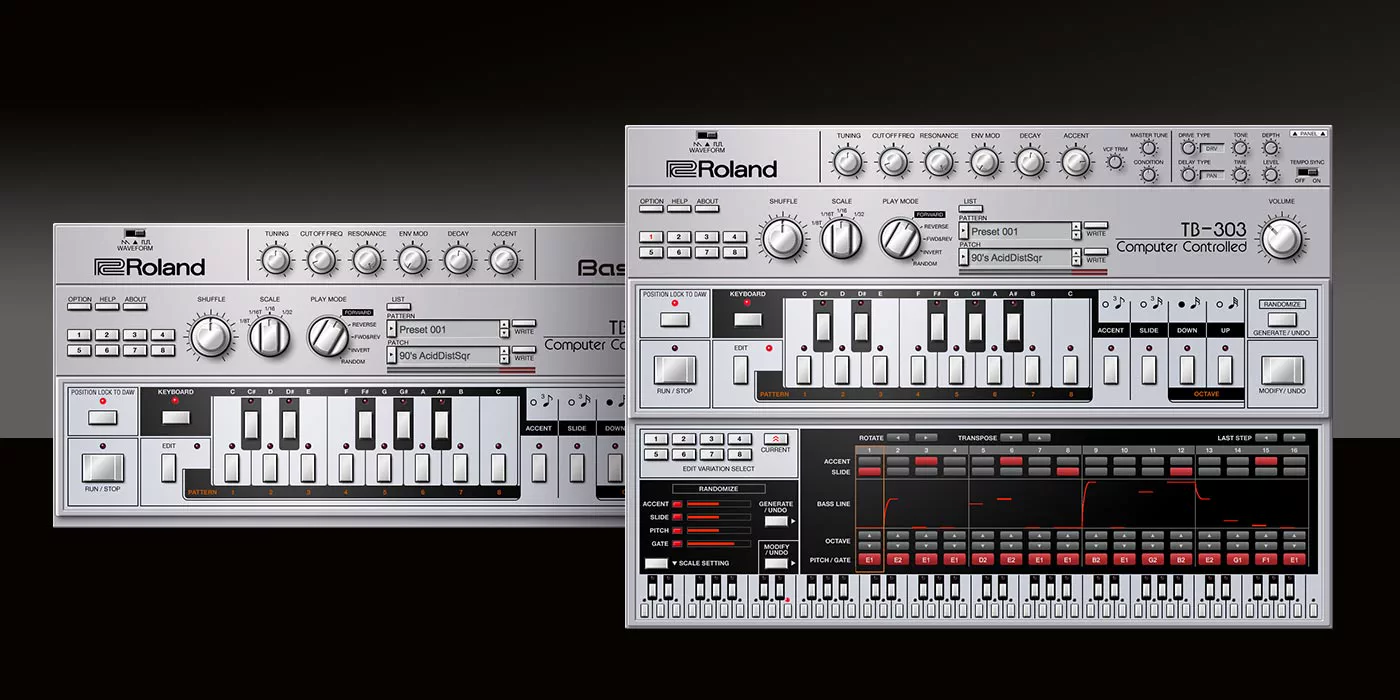
The commercial reversal is remarkable. Roland stopped producing the original because it had not found a sustainable market. Decades later, the company has repeatedly rebuilt the 303 concept: software versions in Roland Cloud, the AIRA TB-3, the Boutique TB-03 and other products use circuit modelling or expanded digital architecture to preserve the behaviour that producers discovered after the original had vanished from shops.
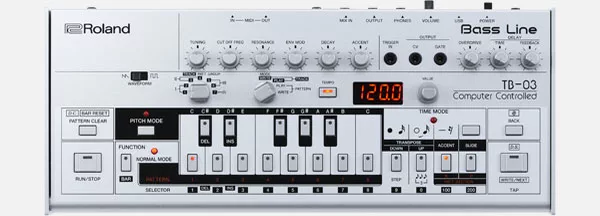
The TB-03 is revealing because its design makes the contrast visible. Roland retained the familiar panel logic — saw/square selection, cutoff, resonance, envelope modulation, decay, accent and the original Pitch and Time programming concepts — while adding an LED display, step-write mode, overdrive, delay, MIDI, USB audio, CV/Gate and more flexible tempo control. The recreation acknowledges that the awkward original workflow was historically important while also correcting the parts that modern users find unnecessarily difficult.
Why emulating a simple synth is surprisingly difficult
On a specification sheet, the 303 does not look complex: one oscillator, two waveforms, one resonant low-pass filter, a simple envelope and a step sequencer. That simplicity is deceptive. The sound depends on component behaviour and on interactions that are difficult to describe as independent blocks. The oscillator shape, filter response, resonance level, accent circuit, slide timing and sequencer gates all influence how the pattern feels.
This is why clones are often judged less by static tone than by movement. A single held saw note can be made convincing with many synthesis methods. The challenge arrives when an accented note slides into another pitch while resonance is high and the cutoff is being moved manually. Small differences in envelope timing or accent response change the groove.
Roland’s later ACB products were explicitly built around modelling this behaviour at circuit level. Other manufacturers have taken analogue-clone approaches, while software developers have modelled the system in code. The continuing market around 303 recreations says something important: producers are not simply buying access to a waveform. They are buying a particular relationship between sequencing and synthesis.
The sequencer still matters in an era of perfect piano rolls
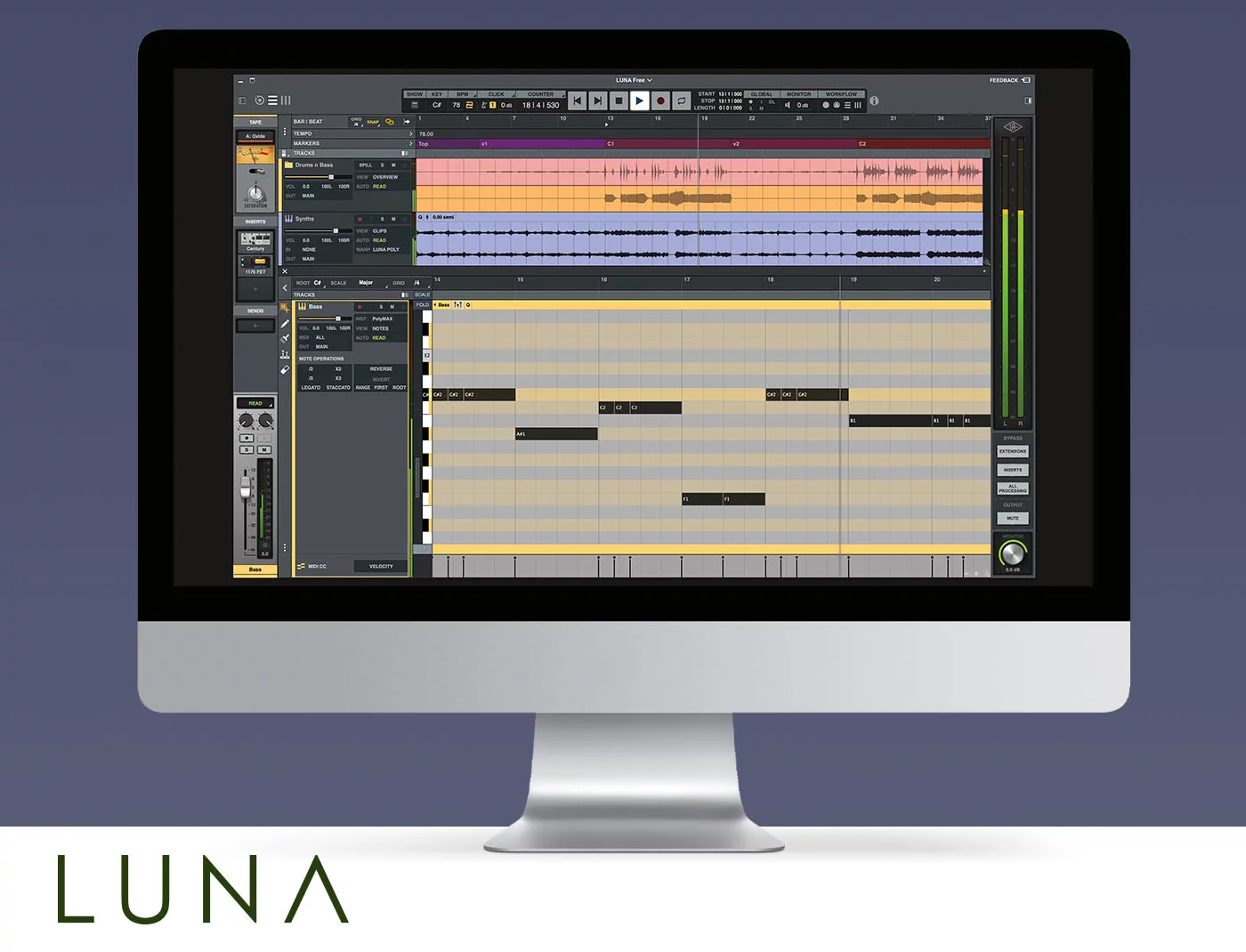
A modern DAW can send any MIDI sequence into a 303 emulation. That is convenient and often musically useful, but it changes the creative process. Drawing notes in a piano roll makes pitch, timing, length and velocity visible at once. The original separates those decisions and hides much of the pattern until playback.
There is no reason to romanticise poor ergonomics for its own sake. Better interfaces save time. What the 303 demonstrates is that interface design shapes musical output. A tool that makes every decision explicit encourages one type of composition; a tool that reveals the result only after several cryptic steps encourages another. The first is efficient. The second may produce surprises.
Many modern recreations therefore offer both approaches. They preserve pattern-based accent and slide while adding graphical editing, randomisation, MIDI drag-and-drop and automation. The old behaviour becomes an option rather than an obligation. That is perhaps the clearest sign that the 303 is now understood as a compositional system rather than merely a vintage tone generator.
Beyond acid: the machine kept escaping its own legend
The most useful contemporary view of the TB-303 is broader than acid nostalgia. Roland’s current programming material demonstrates sub-bass, resonant textures, drones, sound effects, percussion-like chirps and layered sound design using the same basic architecture. Producers have used 303s in electro, techno, trance, ambient, dub-influenced music and experimental work without always foregrounding the familiar acid scream.
This continued expansion fits the instrument’s history. The first creative breakthrough happened because musicians ignored its intended role. Treating acid itself as a new fixed role would repeat the same mistake in reverse. The 303 remains interesting when its controls are treated as material rather than as a recipe.
A closed filter and square wave can produce subdued low-end. High resonance in an upper register can become a texture. Long slides can turn the machine into a strange monophonic lead. Short decay and aggressive accents can move it towards percussion. Multiple instances can be layered into something far larger than a bassline. The architecture is narrow; the performance space inside it is not.
The deeper lesson: users decide what a technology means
The TB-303 is often described as a happy accident, but that wording gives too much agency to the object. The circuit did not decide to invent acid house. A chain of people made decisions: Roland engineers created a bass machine; the first market rejected it; second-hand prices fell; Spanky acquired one; Phuture experimented; DJ Pierre manipulated the controls; Ron Hardy kept playing the tape; dancers learned the sound; other producers copied, distorted and extended the method.





THE CONVERSATION
Opinions, context and replies from the AT-DJ community.