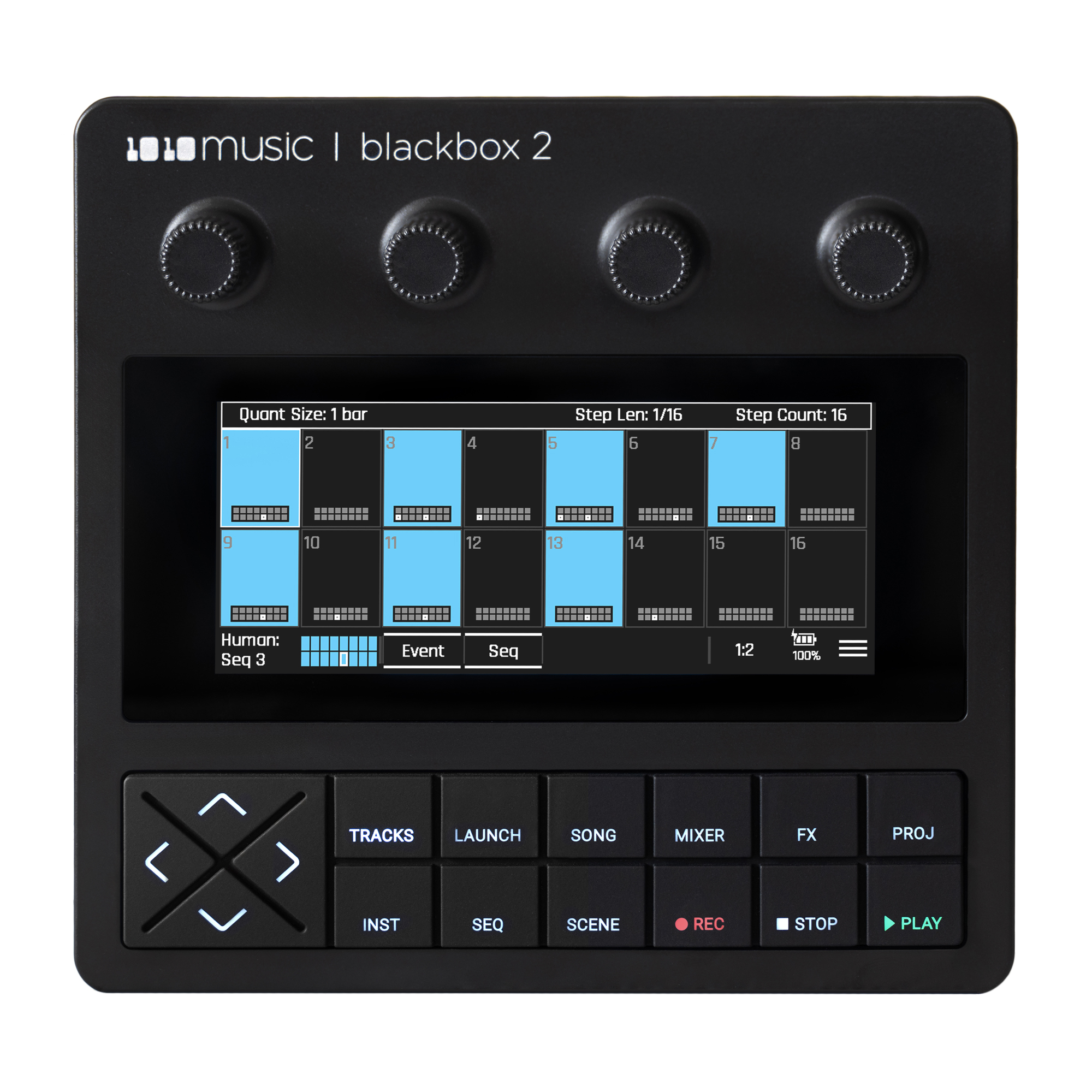
The first blackbox earned a following by putting serious sample playback and sequencing into a very small desktop unit. blackbox 2 keeps that footprint philosophy and expands almost everything around it. 1010music states that the new model has twice the processing power of the original, and the feature set reflects that extra headroom.
Four flexible tracks can host Shredder, One-Shot, Loop, Slicer, Multisample or External Instrument types. One-Shot and Loop instruments can hold 16 samples per patch, while sequencing is available through step, grid/piano-roll and probability-based approaches. For live work, Launch, Scene and Song views make it possible to move from individual clips to full arrangements without rebuilding a set on another device.
The sampling side is broad. Recordings can be triggered by input threshold, synchronised to clock and set to fixed lengths. Internal resampling is available, long WAV files can stream from microSD, and automated multisampling can turn an external synth into a playable blackbox instrument. Live looping gets immediate playback after recording, which matters when the box is used as part of a performance rather than a studio recorder.
Connectivity is unusually generous for the size. There is one stereo input, three stereo outputs and a separate headphone output, plus USB-C host and device ports, TRS MIDI and analogue clock I/O. Multichannel USB audio can send three stereo channels to a computer, tablet or phone and receive one stereo return. The internal battery is specified for several hours of use, making genuinely portable sessions realistic.
The obvious compromise is screen size. Four inches is enough for the interface, but detailed piano-roll edits and sound design demand concentration. Producers who dislike touchscreens will probably want an external MIDI controller nearby. Even so, blackbox 2 packs a large amount of sampling, sequencing and performance logic into a box that remains easy to carry.