Portable music hardware often becomes less portable as features accumulate. Ableton Move takes the opposite route. The machine is built around four flexible tracks and a compact interface, with the emphasis on getting an idea moving before a session turns into project administration.
Those four tracks can host drums, melodic sampling and Ableton instruments, including Drift and Wavetable. That gives each slot more range than the number suggests. A drum track can carry a complete kit, while a melodic part can come from synthesis or recorded material. The limitation is still real, but it encourages grouping decisions early rather than leaving twenty half-used lanes open by default.
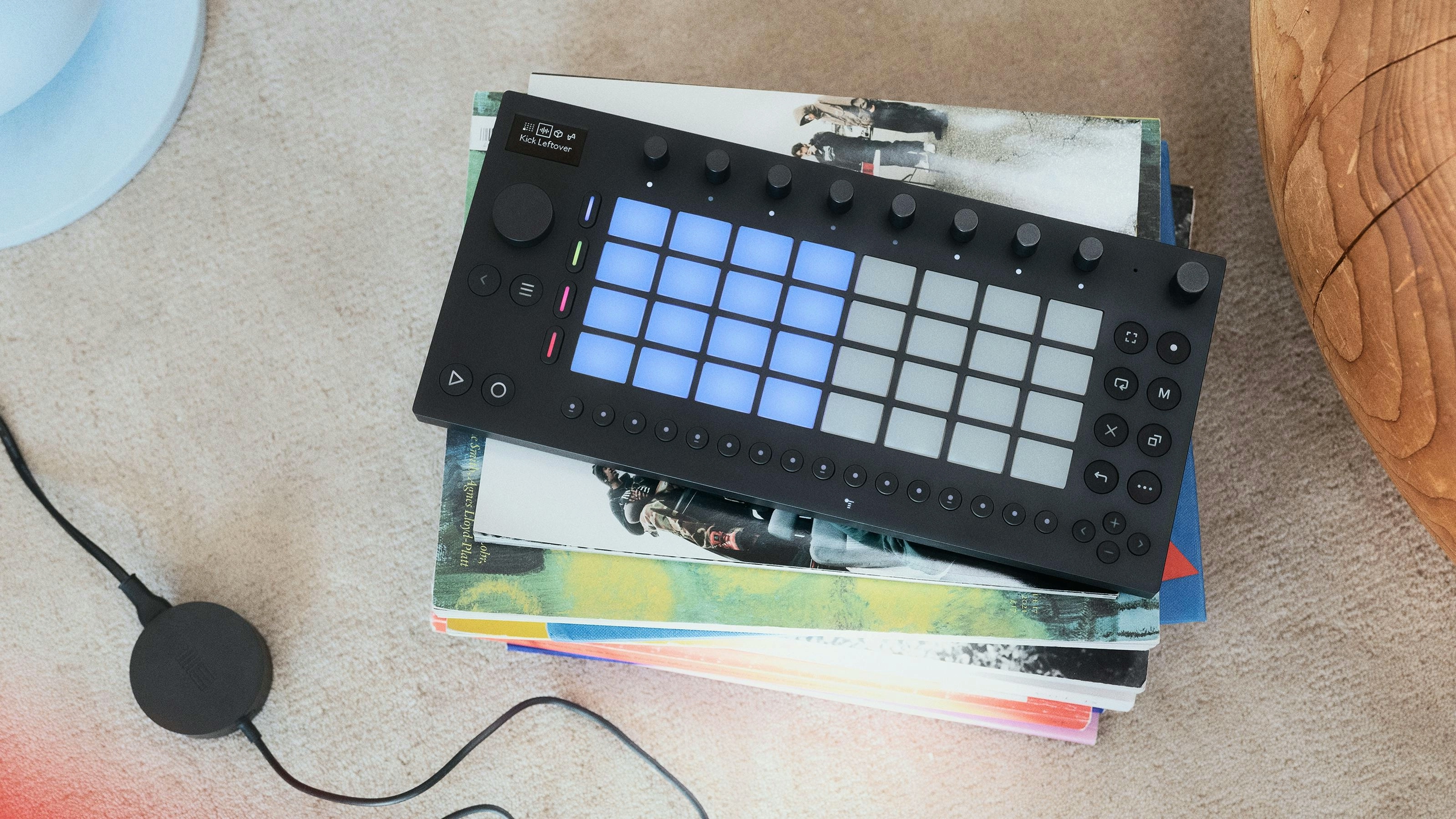
The 32 backlit silicone pads are velocity sensitive and support polyphonic aftertouch, which matters because Move is not only a sequencing box. Chords, pressure-based modulation and finger-drumming can carry expressive variation directly into a pattern. Nine touch-sensitive high-resolution encoders and a small OLED handle parameter work without turning the front panel into a dense control surface.
Sampling is central to the design. Move includes a built-in microphone, stereo input and its own speaker, so capturing a source does not require setting up an external interface. Melodic Sampler and Drum Sampler then push those recordings in different directions. For club-oriented production, the practical value is less about pristine location recording than about getting a percussion hit, voice fragment or environmental texture into a sequence before the impulse disappears.
The current software line has expanded the original concept. Move 2.0 introduced audio-track functionality, giving the box another way to deal with recorded material while preserving the underlying four-track discipline. Ableton has also kept Wi-Fi and Live connectivity central to the workflow. A sketch can begin away from the studio and continue in Live rather than needing to be rebuilt manually.
Internally, Move uses a quad-core ARM Cortex-A72 processor with 2 GB of RAM and 64 GB of storage. Battery life is rated at up to four hours. USB-C handles power and computer connection, while USB-A supports MIDI devices. There are also 3.5 mm stereo input and output connections. These specifications place it closer to a self-contained portable instrument than to a simple Live controller.
The tension is obvious: US$499 is substantial for a device that deliberately limits track count and screen size. Users who want a full arrangement environment, large sample editing views or deep mixing may prefer a laptop or a more expansive groovebox. Move earns its price when those omissions are viewed as protection against distraction rather than missing features.
Its clearest role is between first idea and full production. Ableton has built a hardware environment that speaks the same musical language as Live without trying to shrink Live onto a small display. That distinction is why Move feels coherent rather than incomplete.
Independent AT-DJ editorial assessment based on verified manufacturer specifications, documentation and current product information. No paid commercial relationship with the manufacturer is involved.