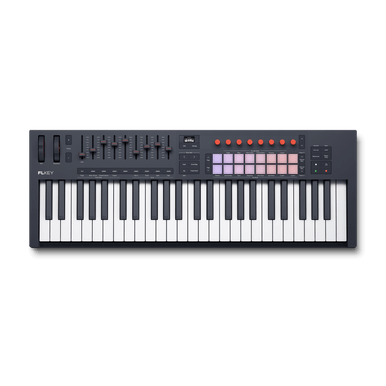
FLkey 49 MK2 makes most sense as a controller for people who already know where FL Studio slows them down. The official specification is not built around one dramatic feature. It is built around reducing small interruptions: mixer moves, Channel Rack control, plugin parameters, transport, undo, Score Log, Pattern and Song mode, all moved closer to the keyboard. The 49-key semi-weighted format is the important middle ground. It gives enough range for chords, bass movement and two-handed sketches without turning the controller into studio furniture. The 16 RGB pads add another layer because they are not just launch buttons. Novation describes them as velocity-sensitive and polyphonic-aftertouch capable, which matters for finger drumming, melodic triggering and expressive pressure gestures inside supported workflows. The NKS angle is also practical. FL Studio users often work with a mix of native devices, third-party plugins and sample instruments. A keyboard that can speak to Native Kontrol Standard reduces the feeling that every plugin is a separate little island. That does not make mapping problems disappear, but it gives the controller a wider life than a single DAW skin. The risk is dependence on integration quality. A controller like this only earns its place if the automatic mappings are predictable and the OLED feedback is clear enough to stop users looking back at the screen every few seconds. Eight encoders and nine faders are generous, but they become clutter if the current target is not obvious. As a hardware proposition, FLkey 49 MK2 looks strongest for producers who want FL Studio to feel more like an instrument during the first hour of a track. It is less compelling for users who mostly draw notes, mix with a mouse or move between DAWs without caring about deep FL-specific buttons. The product is focused, and that focus is the point: it gives FL Studio a more physical front panel.
AT@DJ editorial review based on official public product information; no paid placement or loan unit is claimed.