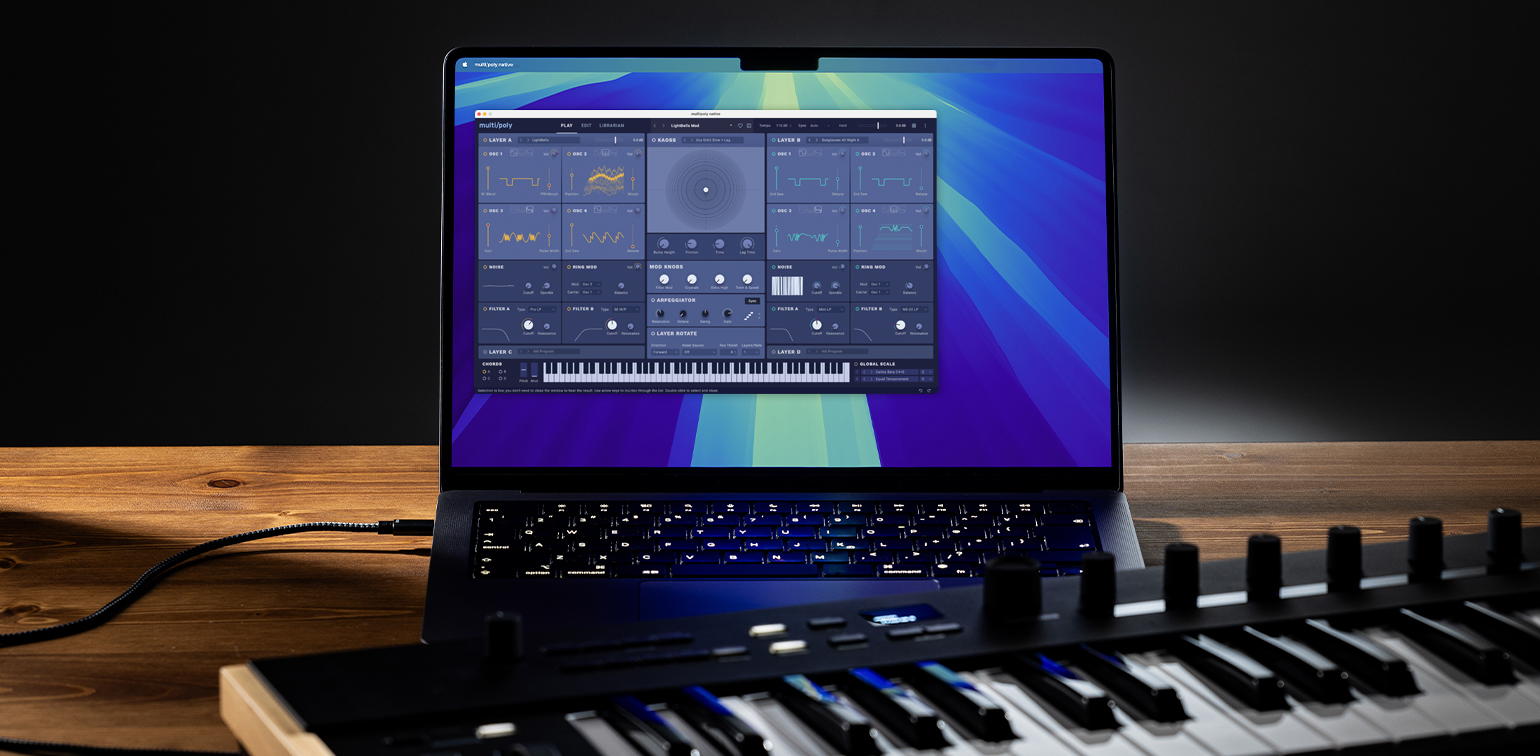
KORG's multi/poly hardware takes inspiration from the company's early analogue polysynth lineage, but the modern instrument is much broader than a historical recreation. multi/poly native brings the same synthesis architecture into software, preserving the idea of Programs inside larger Performances and allowing patch exchange with the physical keyboard.
Each Program can use four oscillators. Classic, Digital and Waveshaper modes cover a wide range of starting material, from familiar analogue-style shapes to more explicitly digital spectra and distortion-based generation. That already makes one Program capable, but a Performance can contain up to four Programs, which is where the instrument moves into layered pads, split textures and evolving composite sounds.
The filter section is similarly broad. Two independent filters per Program can draw on a collection of modelled responses rather than forcing every patch through one house sound. This matters when four layers are active: one Program can provide a narrow resonant motion while another remains wide and stable, reducing the need to solve every contrast with external EQ.
Modulation is where multi/poly native earns its scale. Four loopable DAHDSR envelopes, five LFOs and six Mod Processors sit alongside Motion Sequencing 2.0. Instead of treating sequencing as a separate note generator, Motion Sequencing can animate parameters over time. For techno, ambient and other repetitive forms, that makes long-held notes capable of carrying their own arrangement detail.
Layer Rotate introduces another useful performance concept by distributing notes between Programs according to chosen behaviour. A chord or repeated figure can therefore cycle through contrasting timbres without programming multiple MIDI tracks. Kaoss Physics adds a more gestural modulation source, using movement in a virtual space to drive parameters. These features give a highly technical synth several ways to be played rather than merely configured.
Each Program supports three insert effects, so layered Performances can build significant processing internally. That can simplify session routing, although it also increases the temptation to make every patch enormous. multi/poly native is at its best when its depth is used selectively: one or two distinctive motion ideas often carry further than activating every layer and modulation source at once.
The software supports VST3 and AAX on Windows and macOS, with Audio Unit on macOS, plus standalone operation. Hardware owners can move sounds between versions, which makes the plugin useful as an editor, recall system and studio counterpart rather than a separate product family.
multi/poly native is not aimed at producers who want a minimal synth with a handful of macro controls. Its appeal is the opposite: a deep layered system with enough modulation and oscillator variety to keep one instrument active across basses, pads, sequences and sound-design duties.
Independent AT-DJ editorial assessment based on verified manufacturer specifications, documentation and current product information. No paid commercial relationship with the manufacturer is involved.