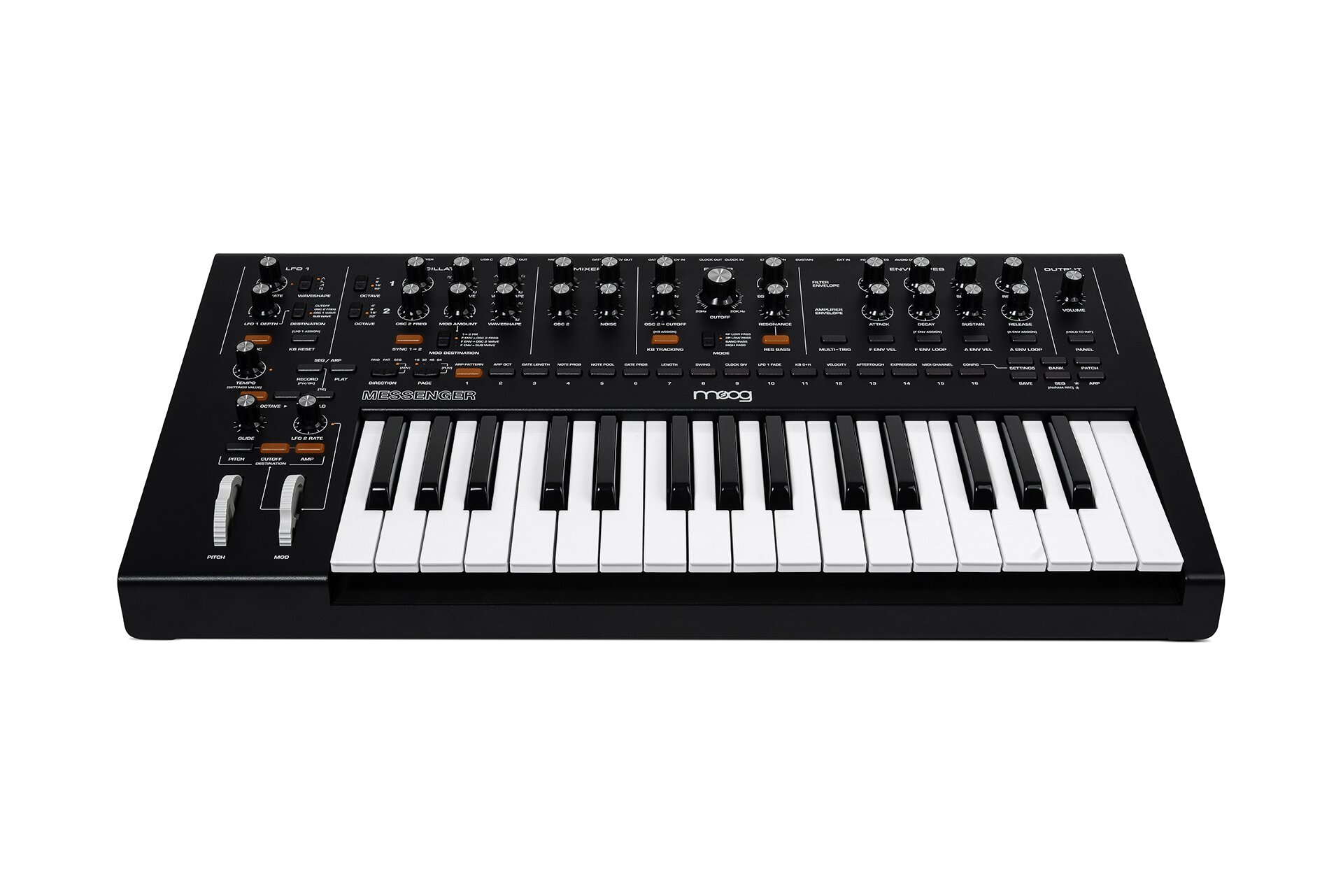
Moog Messenger sits in a practical part of the synth market: compact enough to be approachable, but specified beyond the limits of a simple vintage-style mono synth. The official information lists a 32-key analog keyboard, a 64-step sequencer, 256 presets, wavefolding oscillators and next-generation filtering. Those details give Messenger a clear role. It is not trying to be a polyphonic centrepiece, a modular system or a full production box. It is a focused mono instrument with recall, sequencing and hands-on sound shaping. That combination matters for producers who want one strong line, bass movement or lead part without building an entire patching environment around it. Presets change the way a mono synth can be used. They make it easier to return to ideas, prepare live material and move between sessions without rebuilding each sound from zero. The trade-off is familiar: too much reliance on memory can flatten discovery, while good recall can make hardware useful beyond the first burst of enthusiasm. Moog’s mention of wavefolding deserves a careful reading. It points toward a wider harmonic range than a traditional subtractive voice, but it does not automatically tell us how expressive the instrument feels. Without hands-on testing, it would be wrong to describe the sound in detail. The official specification only supports a more modest conclusion: Messenger is designed to move between familiar analog duties and sharper, more animated tones. For club-oriented musicians, the strongest use may be narrow rather than universal. A mono synth can carry a bassline, a repeating sequence, a hook or a pressure layer that cuts through a mix. The 64-step sequencer gives that role structure, while presets make it easier to bring those parts back in a live or studio workflow. The Moog name brings cultural weight, but a new instrument should not be judged only by how closely it resembles older machines. Messenger is more useful when treated as a current working synth: one voice, stored sounds, sequence movement and direct controls. Its value will depend on whether that set of choices feels immediate once a track is being built, not on nostalgia alone.
AT@DJ editorial article based on official public information; no manufacturer loan or paid placement is claimed.