Kontakt has long been less a single instrument than a format, a host and a development environment. That scale is its advantage and its problem. Producers can access extraordinarily detailed libraries, but opening Kontakt has traditionally made the most sense when a specific sampled instrument was already the goal. Version 8 tries to make the platform more useful earlier in the creative process.
Leap is the clearest example. It provides a loop-oriented workflow where material can be sliced, triggered, transformed and performed without treating every sample as the beginning of a full instrument-building session. Native Instruments includes a collection of Leap Expansions, giving the browser a more immediate role for beat making and texture work. In electronic music, that makes Kontakt less dependent on orchestral, acoustic or cinematic library logic.
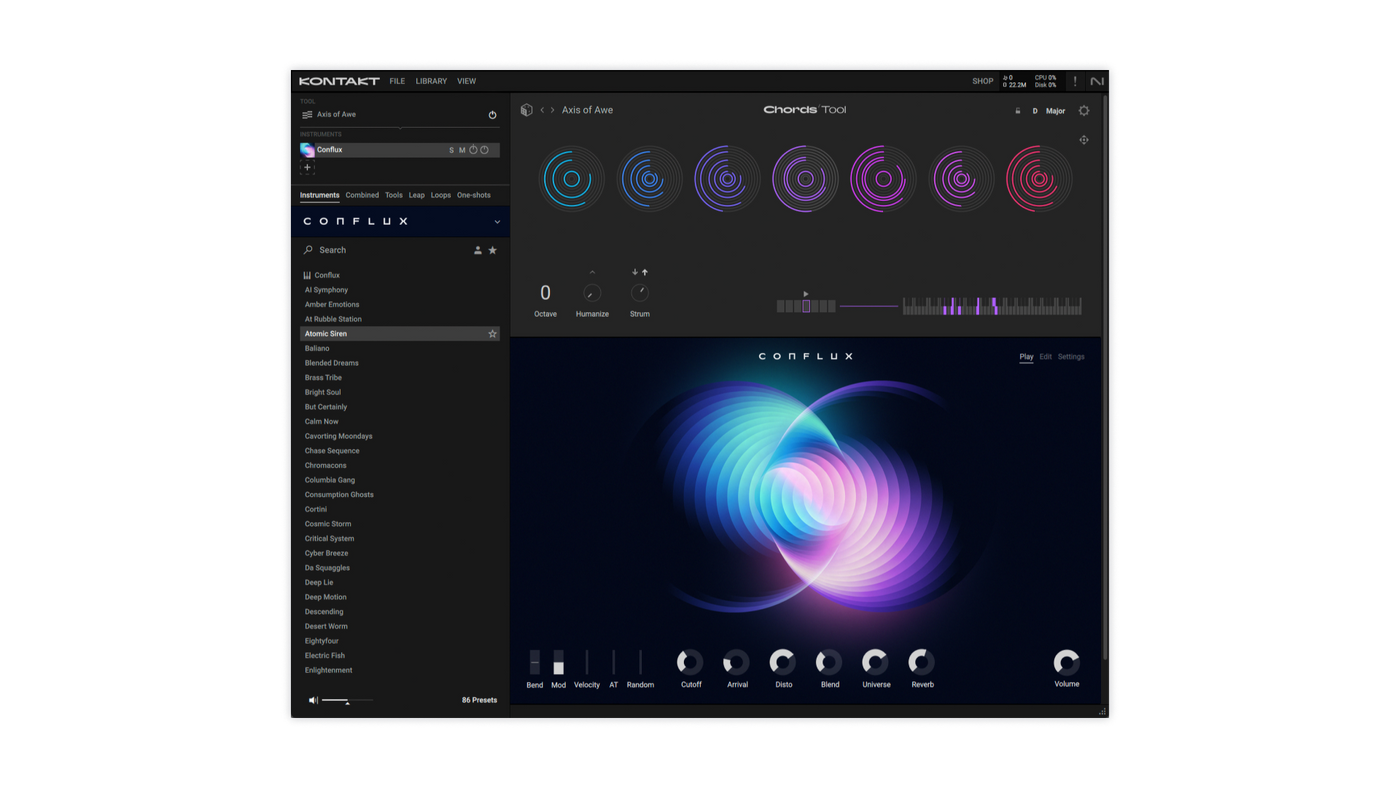
The new Tools layer moves in a related direction. Scale Lock, Chord Builder and Humanizer can shape incoming or generated musical data before it reaches an instrument. These are not glamorous additions, but they can shorten the route from an awkward MIDI sketch to something playable. A chord idea can stay inside a chosen scale, repeated notes can be loosened, and harmonic structures can be generated without rebuilding the entire part in the DAW.
Conflux is the flagship example of Kontakt 8 behaving like a hybrid synthesiser. It combines sampled material with wavetable techniques and additional synthesis processes including FM, phase and ring modulation. That gives the platform a route into evolving pads, motion-heavy sequences and electronic textures that are not defined by realism. For producers who mainly associate Kontakt with multisampled pianos or strings, Conflux is a useful statement of intent.
The established side of Kontakt remains substantial. The Factory Library contains hundreds of instruments, while the wider third-party ecosystem is still the main reason many studios keep Kontakt installed. High-DPI work has expanded across the browser and newer instruments, and the application supports current 64-bit VST3, AU and AAX environments alongside standalone operation.
This breadth comes with weight. A full installation occupies significant storage, and the interface necessarily contains concepts that a simple sampler can ignore. Kontakt is not the quickest choice for every one-shot or basic drum edit. Its value appears when a production needs to move between deep sampled instruments, custom scripting, loop manipulation and hybrid sound design without changing platform.
At US$299, Kontakt 8 is easier to justify for producers who will use the ecosystem rather than a single bundled instrument. The version's strongest achievement is that the ecosystem now feels less passive. Instead of merely browsing increasingly large libraries, users have more tools for turning source material into parts that belong to the track in front of them.
Independent AT-DJ editorial assessment based on verified manufacturer specifications, documentation and current product information. No paid commercial relationship with the manufacturer is involved.