The CR-78 has always occupied a different corner of Roland’s drum-machine history. Its sounds are smaller and softer than the machines that later defined house and techno, but that restraint is exactly why it still turns up in electronic production. The new software version preserves the original instrument set while giving each voice enough control to function inside a modern mix.
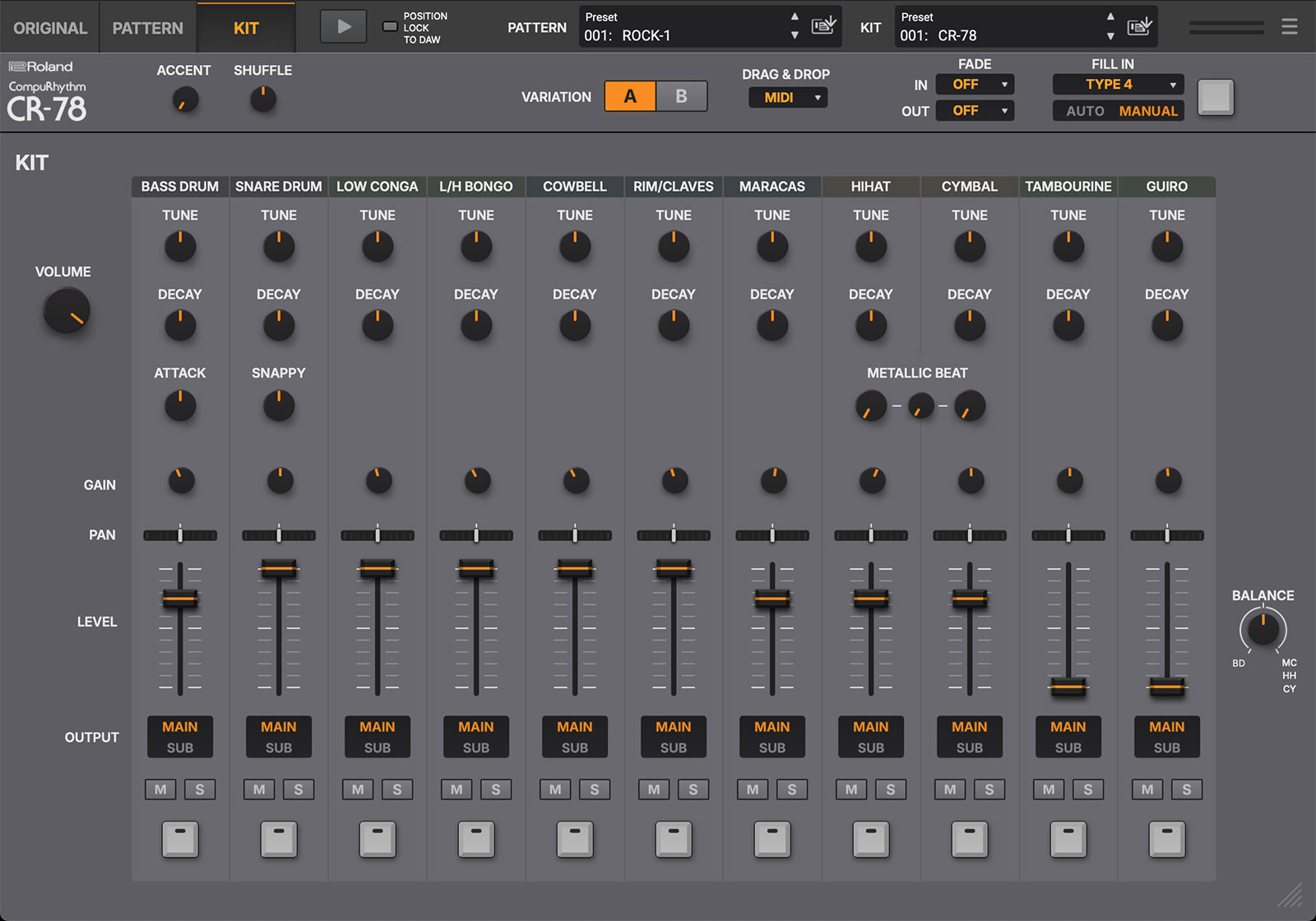
The plug-in provides 11 instrument parts, including bass drum, snare, congas, bongos, cowbell, rimshot/claves, maracas, hi-hat, cymbal, tambourine and guiro. Each channel gets tuning, decay, pan and level, with extra parameters where they make sense. The kick has Attack, the snare gets Snappy, and routing can send instruments to main or sub outputs.
The sequencer is where the software moves furthest beyond historical recreation. Each lane can use independent shuffle and last-step settings, while sub-steps, flams, alternate hits and weak hits add movement that would have required much more work on the original hardware. Two pattern variations per pattern and straightforward mute/solo controls make it easy to build arrangements rather than treat the plug-in as a loop player.
Roland also includes all of the original patterns, which is useful for understanding why the CR-78 has such a particular rhythmic feel. They work better as starting points than museum pieces. Once shuffled, shortened or re-voiced, those patterns can sit naturally in downtempo, leftfield house, electro, indie dance and more stripped-back club tracks.
DAW integration is sensible. VST3, AU and AAX are covered, patterns sync to host tempo, parameters can be automated and MIDI or rendered audio can be dragged straight onto the timeline. The main limitation is obvious: this is still a CR-78. Its compact, woody palette is the appeal. If you expect one drum plug-in to cover every modern electronic style, this is too specific.