Surge XT 1.3.4 strengthens one of the most unusually expansive free synthesizers available to electronic producers. The update improves wavetable compatibility, extends Open Sound Control to the separate effects plug-in, and refines tools that matter when a synth becomes part of a larger, automated studio. It is not a redesign built around a new preset browser or a single fashionable synthesis method. Its appeal remains the ability to move between oscillator architectures, modulation strategies and tuning systems inside one instrument.
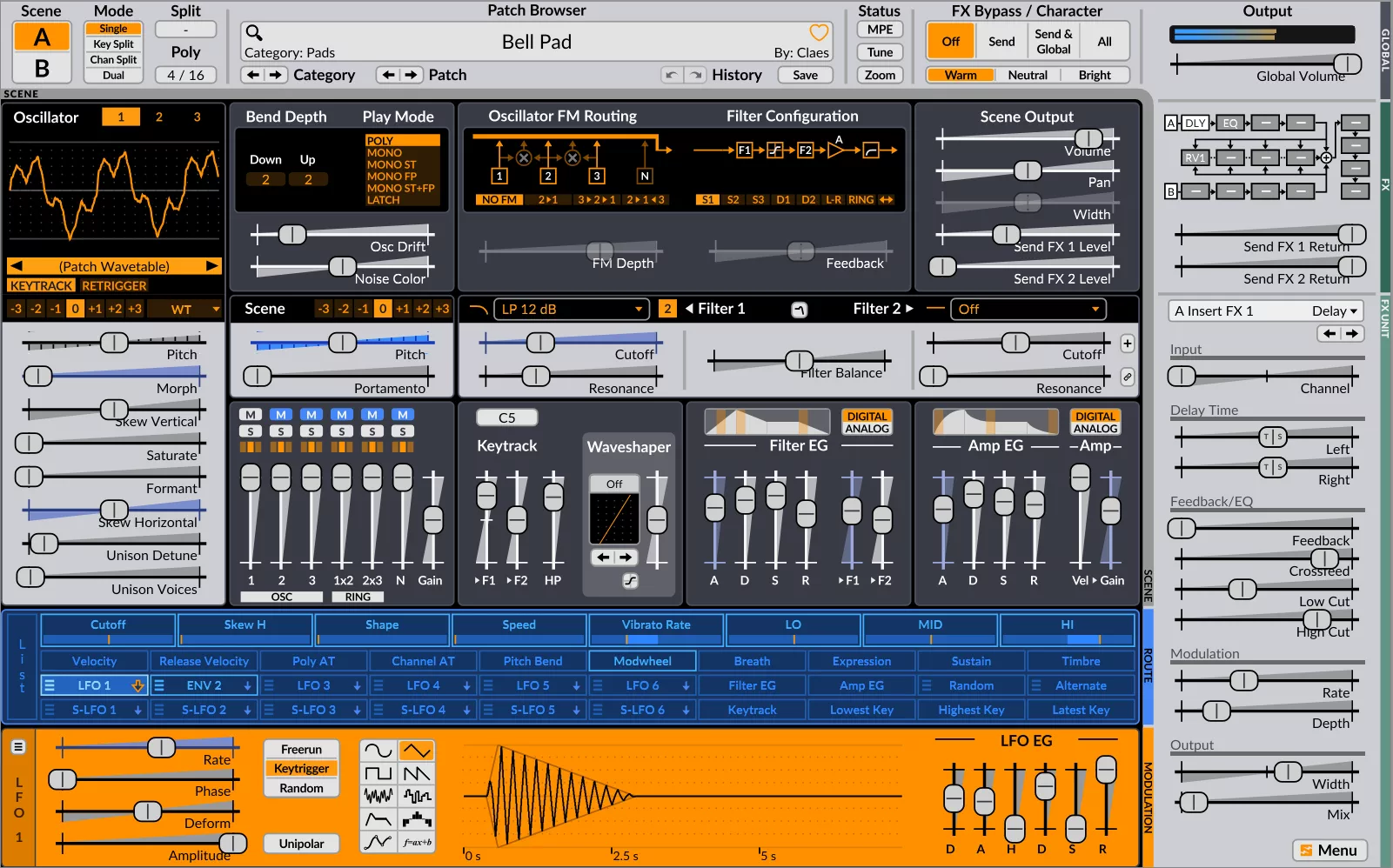
The stable 1.3.4 release is particularly relevant for producers building sounds that change throughout an arrangement. Surge XT provides two independent scenes per patch, three oscillators in each scene and a sizeable modulation system. Those components can support a tightly focused mono bass, a layered evolving texture or an arrangement where two distinct timbres occupy different ranges. The flexibility is real, but it comes with a dense interface: the breadth that attracts experienced sound designers may demand patience from musicians who primarily want to select a patch and write a melody.
Twelve oscillator approaches, two complete scenes
The oscillator selection moves well beyond a conventional saw-and-square palette. Surge XT's official specification lists twelve oscillator algorithms, including Classic, Modern, Wavetable, Window, FM2, FM3, String, Twist and Audio Input. That spread matters because different oscillator engines invite different ways of shaping a sound. A wavetable patch may rely on scanning a complex waveform, while an FM-based texture gets its motion from relationships between carrier and modulation signals. The important distinction is that these engines inhabit the same patch architecture rather than requiring a different instrument for each synthesis approach.
Each scene also carries its own filter and modulation structure. Layering two scenes is a practical path to building a sound with contrasting attacks and sustained components, while split configurations help separate keyboard regions. The factory library includes more than 2,800 patches and over 700 wavetables according to the project website. That gives beginners substantial material to explore, but does not remove the learning curve of programming an instrument with so many routing possibilities. The strongest value emerges when presets become starting material for detailed editing.
What 1.3.4 actually changes for wavetables
Version 1.3.4 makes a targeted change to the Wavetable and Window oscillators: they now correctly interpret full-range 16-bit WT files. The developers explicitly identify factory wavetable files from Bitwig Studio as compatible as a result. This is more meaningful than another bundle of generic preset names. Sound designers who maintain custom wavetable collections need reliable interchange, and mismatched interpretations of file range can alter how imported material behaves. The change concerns file handling; it should not be confused with a newly invented synthesis engine.
Beyond twelve-tone synthesis
Surge XT also supports microtuning through Scala and MTS-ESP and offers MPE capabilities for expressive controllers. These features broaden its appeal outside standard twelve-tone keyboard performance. The possibilities range from alternate scales to per-note expression, provided the host and controller setup support the relevant data. They are especially relevant in experimental techno, ambient and sound art, where subtle tuning relationships or gestures can become central musical material. They do require more configuration than simply loading a subtractive synth preset.
OSC control moves into the effects plug-in
Open Sound Control is another part of the instrument's identity. OSC allows compatible external applications and interfaces to exchange structured control messages with a synthesizer. In 1.3.4 the separate Surge XT Effects plug-in gains OSC support, and the release also refines handling of OSC message types and tuning display updates. The project's ongoing OSC work has particular potential in custom performance systems, interactive installations and studios using networked controllers. It should not be mistaken for automatic compatibility with every control surface: routing and mappings still have to be configured.
Beyond the graphical instrument, the project offers a command-line path and Python bindings. The 1.3.4 notes add handling for input and output audio buses, update tempo and position handling, and allow a command-line process to operate without waiting for standard input. These are specialized additions, but they give Surge XT uses that conventional desktop synth plug-ins rarely advertise. A technically minded musician can integrate its engine into scripts or headless workflows; an ordinary DAW producer can ignore that entire layer without losing the core instrument.
Formats, workflow and the learning curve
The software remains available as a standalone application and in several plug-in formats. Official downloads list VST3 and CLAP for Windows, AU, VST3 and CLAP for macOS, and LV2, VST3 and CLAP for Linux. Format support is not the same as a guarantee that every host configuration works identically, so the exact operating system and host should be checked before installing. The official release page recommends 1.3.4 for routine music production; newer nightly builds are offered separately and are explicitly development builds.
At zero purchase price, Surge XT has an unusually strong specification. But a zero price alone does not make it the correct synth for every producer. A compact instrument with a simpler signal path may be quicker for everyday editing, while Surge XT rewards those willing to learn its scenes, oscillator families, effects and modulation assignments. Its interface presents a lot of information, and the abundance of choices can interrupt a fast sketching workflow when the sound in mind is simple.
The most persuasive argument for Surge XT 1.3.4 is its continuity: a versatile instrument maintained through concrete compatibility fixes and increasingly sophisticated control options. The wavetable improvement matters to people exchanging sound material; OSC development benefits custom rigs; the familiar two-scene architecture remains capable of both disciplined programming and long, evolving electronic textures. For producers who want an open-source synth with room to grow, it is an exceptionally credible choice, provided they are comfortable with its depth.
Sources: Surge Synth Team's official product specification, download page and 1.3.4 changelog. Image: Surge Synth Team / Wikimedia Commons, CC BY-SA 4.0, https://creativecommons.org/licenses/by-sa/4.0/.