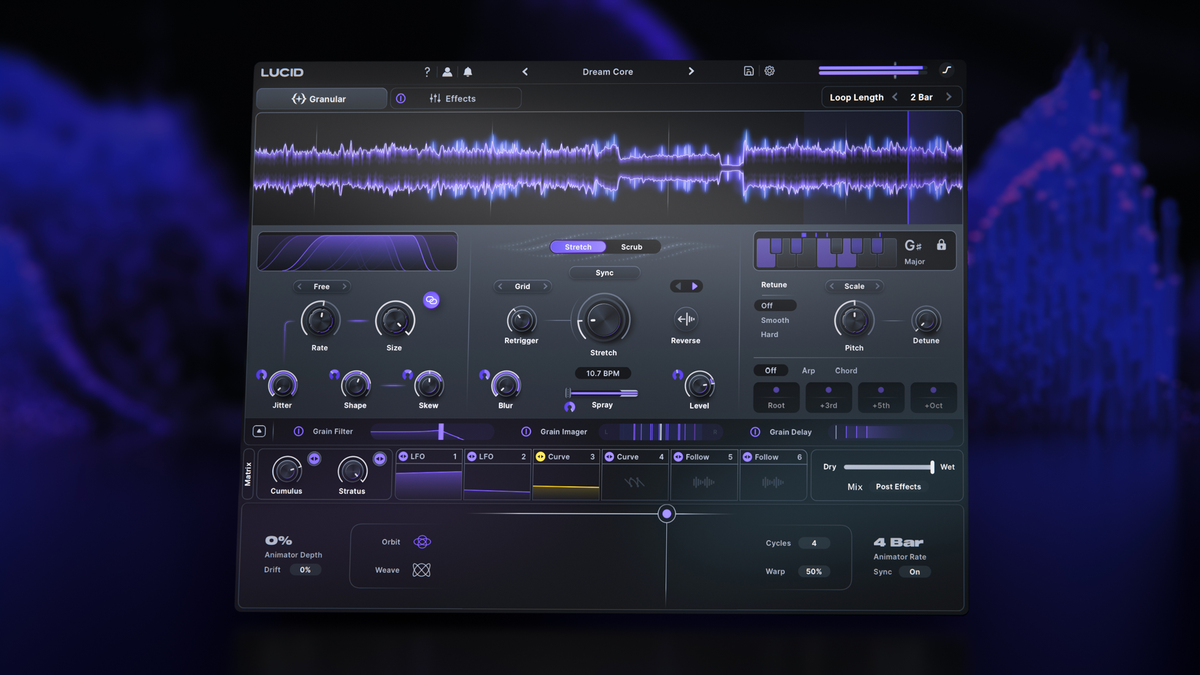
Granular effects are very good at producing impressive sounds and equally good at producing sounds that have no obvious place in a track. Minimal Audio’s Lucid is built around that gap. The core granular engine is deep, but several of its most useful choices are tied directly to musical context: timeline position, BPM and scale.
The grain engine can lock pitch to a chosen scale, which makes clouds and pitched fragments easier to use harmonically. Stretching and scrubbing can follow the project timeline, so rhythmic transformations stay connected to the arrangement rather than drifting into a separate sound-design exercise. That is a simple idea with a large practical effect.
Lucid also puts processing inside individual grains. Filtering and other timbral changes can happen at grain level before the signal is summed, allowing movement that would be difficult to reproduce with a conventional effect chain after the granular stage. A full modulation system sits underneath, with visual feedback that makes complex motion easier to read.
The plug-in does not force one granular method. Scale-locked pitch shifting, free pitch shift and classic repitch behaviour are available, while sync, stretch and scrub modes cover a broad range of rhythmic and textural uses. The 350-plus presets are particularly useful here because Lucid can move from subtle harmonic layering to complete source destruction.
The interface is not minimal despite the company name. There are enough controls to reward learning, and producers who only want a quick shimmer or freeze effect may prefer something simpler. For electronic production, though, the depth makes sense. Lucid is strongest when it stays inserted on an active part of the arrangement and becomes part of the composition rather than a special-effect stopover.