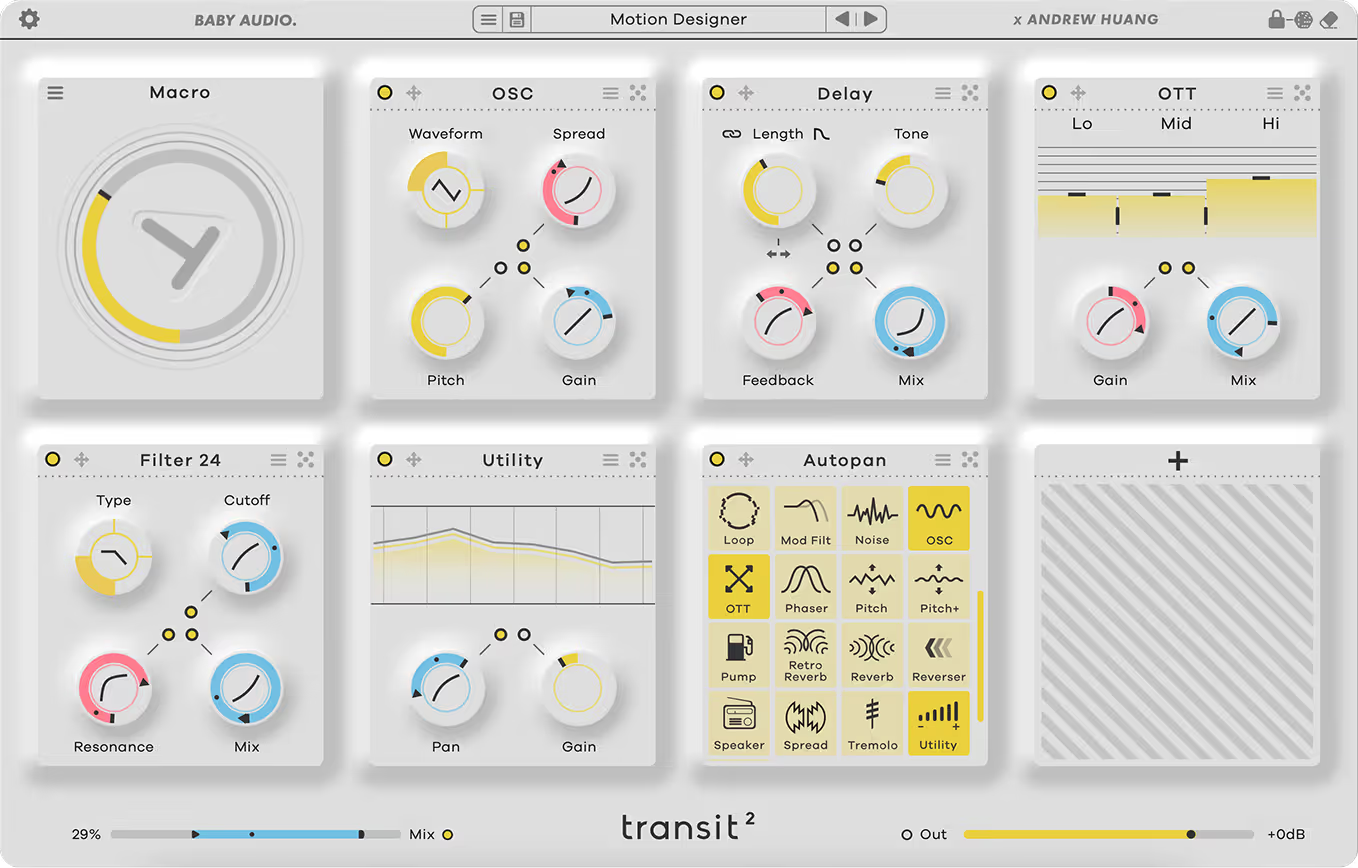
Transitions are a slightly awkward part of electronic production. They are essential to arrangement, yet they often end up spread across several tracks and automation lanes: filter cutoff rises on one channel, reverb size increases on another, a noise sweep appears somewhere else, delay feedback climbs, distortion opens up, then everything needs to land cleanly on the next section. Transit 2 is designed to put that movement into one coordinated system.
The plug-in contains 28 effect modules covering filters, modulation, degradation, vintage colour, reverb, delay, compression, oscillator and noise sources, among other tools. Those modules can be reordered freely. More importantly, each parameter can either stay static or connect to the global motion setup. That is what makes Transit 2 feel different from an ordinary multi-effect rack.
There are six motion modes. Macro is the most direct: one control moves multiple parameters together. LFO handles cyclic modulation. Follower responds to the dynamics of the incoming track. Sidechain lets another signal drive the movement. Gate is designed for immediate triggering, which is especially useful for performance. Sequencer can launch tempo-synchronised transitions without building a long automation curve by hand.
For club music, the practical applications are obvious. A breakdown can gradually remove low end while increasing reverb, widening the stereo image and introducing noise. A drum bus can be pushed into a short degraded fill before a drop. A pad can pulse in response to the kick through sidechain motion without turning the whole signal into conventional volume pumping. A live set can trigger a complete transformation with a gate rather than relying on a perfectly timed mouse move.
Transit 2 also improves on the original concept by making movement less dependent on one giant transition knob. Follower, Sidechain, Gate and Sequencer modes allow the effect to behave as part of the music rather than as a pre-scripted sweep. That makes it more useful beyond obvious risers. It can create rhythmic modulation, evolving textures and dynamic processing that reacts to the arrangement.
The 28 modules are broad enough to cover most transition duties, and the inclusion of oscillator and noise sources matters. Many producers otherwise keep separate riser samples or noise generators simply to create energy between sections. Here those elements can live inside the same motion chain as filters, delays and reverbs.
There is a danger, of course. A plug-in this immediate makes it very easy to add movement everywhere. Not every eight-bar section needs a giant sweep, stereo spin and reverse delay. Some of the strongest club arrangements rely on one mute, one filter move and a well-timed return of the kick. Transit 2 works best when it replaces unnecessary complexity rather than encouraging more of it.
At the current $79 sale price, the value is strong for producers who spend real time on arrangement, automation or live transitions. The regular $129 price is still defensible because the plug-in combines a substantial effects collection with an unusually coherent modulation system. It will be less essential for minimal workflows where transitions are built from a couple of stock effects, but for detailed electronic production it is one of BABY Audio's most purpose-built tools.
AT-DJ did not conduct an independent hands-on test of Transit 2. This editorial assessment is based on official documentation, verified specifications, public demonstrations and current pricing. BABY Audio did not sponsor or pay for this review.