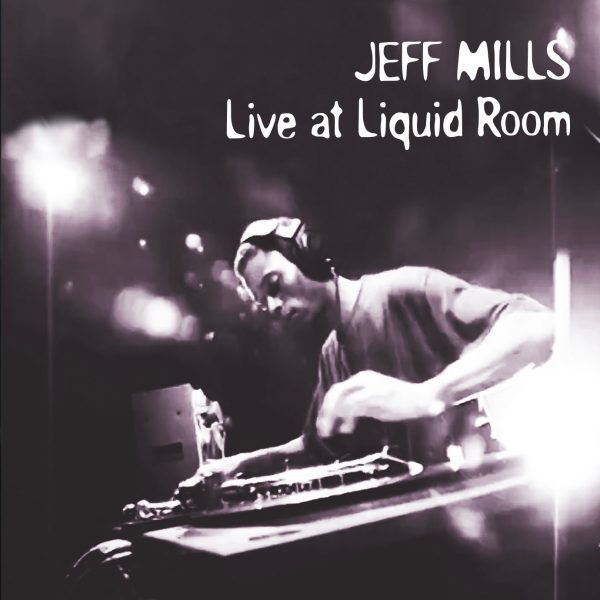
Axis Records is reissuing Jeff Mills’ Live at Liquid Room to mark three decades since the set was recorded in Shinjuku, Tokyo, on 28 October 1995. The label has also announced a world tour built around the anniversary. Originally released in 1996, the 67-minute recording remains one of the clearest documents of Mills at full velocity: abrupt, precise, restless and completely uninterested in making the machinery disappear.
The tracklist still reads like a compressed map of techno’s mid-1990s nervous system. Detroit futurism sits next to Chicago pressure, European loop tools and tracks that would become permanent reference points. Mills moves through his own material alongside Surgeon, Joey Beltram, DJ Funk, Ken Ishii, The Advent, Claude Young and Rhythm Is Rhythm. The famous names matter, but the real story is how little time he gives any of them to settle.
A mix that never behaves like a museum piece
Anniversary editions often arrive wrapped in reverence. Liquid Room resists that treatment because the performance itself is too volatile. Mills does not present tracks as complete objects. He cuts into them, overlaps them and leaves before their internal logic has fully resolved. The mix is constantly opening doors and slamming them shut. That pace can sound brutal, yet it is not random. The set has a strong sense of architecture, built from pressure rather than long-form blending.
This is why the recording still lands with DJs who discovered it years after the fact. Its influence is not tied to a single production style. The tempos, textures and records belong to a particular period, but the underlying attitude remains usable: selection as editing, rhythm as narrative and technique as a way to keep the room alert. Mills treats every transition as a decision with consequences.
The sound of three decks used as an instrument
Mills’ reputation as a three-deck technician is central to the mythology around the mix, but virtuosity is only part of the appeal. What matters is the way the decks create density. A percussion loop might sit under a bassline for seconds before being replaced by another fragment; a recognisable hook appears, does its job and vanishes. The set often feels closer to live rearrangement than conventional track-to-track mixing.
That distinction is important. Technical DJing can become theatre, especially when speed and difficulty are treated as ends in themselves. On Liquid Room, the technique rarely asks for applause. It is functional, almost severe. Mills is trying to shape energy faster than a single record allows. The performance works because the gestures remain connected to the floor rather than to a demonstration of skill.
Tokyo in 1995, Detroit in the machine
The recording also captures a specific moment in techno’s international spread. By 1995, Detroit’s ideas had travelled widely, but they were being interpreted through different club cultures, labels and production methods. Japan had become a crucial audience for electronic music, and the Liquid Room provided a setting where that exchange could be heard in real time. Mills brought Detroit’s sense of futurism, but the set was not a lecture in heritage. It was a working club performance.
That matters because techno histories are often simplified after the fact. Scenes become timelines, artists become symbols and messy exchanges are tidied into origin stories. Liquid Room keeps the mess audible. Chicago jack tracks collide with European tools; hard-edged loops sit beside strings associated with Detroit’s emotional core. The mix does not resolve those differences. It uses them.
Why the pacing still feels radical
Many contemporary festival sets are built around legible peaks. Tracks are given enough space for the crowd to recognise the drop, phones rise, and the arrangement moves towards the next obvious moment. Liquid Room operates differently. Its peaks are brief and unstable. Mills often cuts away just as a record seems ready to dominate, which creates a feeling of permanent forward motion.
The effect is physical, but also psychological. The listener is denied the comfort of completion. A groove may lock for half a minute, then dissolve into another layer. Familiar tracks appear in partial form, so recognition becomes part of the rhythm rather than the destination. This can be demanding, especially for ears trained by cleaner, longer blends, but that demand is part of the set’s character.
A document from before the DJ became content
The anniversary arrives in a culture where DJ performances circulate instantly as clips, livestreams and branded visual packages. None of that automatically diminishes the music, and Mills himself has worked extensively with film, orchestras, installation and large-scale staging. Still, Liquid Room belongs to a period when the mix could become legendary through sound alone. Its image was largely constructed in the listener’s head.
That makes the reissue useful beyond nostalgia. It gives younger listeners access to a performance whose reputation was built through tapes, CDs, file sharing and word of mouth. It also offers a counterpoint to the idea that a memorable DJ set requires a spectacular visual identity. Here, the drama comes from timing, EQ, selection and nerve.
The tracklist as a living archive
The 38-track sequence includes several records that now carry canonical status, among them Strings of Life, The Bells, Changes of Life and Ken Ishii’s Extra in Luke Slater’s remix. Yet the mix does not treat them as monuments. Even its biggest records are folded into a larger current. Their historical weight is something listeners added later; in the room, they were tools for immediate movement.
That difference is worth holding onto. Dance music archives can become overly respectful, as if classic records should be approached in perfect condition and heard from beginning to end. Club history was often made through misuse, fast mixing, damaged copies and moments that existed once. Liquid Room survives because it captures that instability without sanding it down.
What an anniversary tour can and cannot reproduce
The world tour attached to the reissue will inevitably carry expectations. No present-day performance can recreate the exact social, technical or musical conditions of Tokyo in 1995, and trying to reproduce the set track for track would miss the point. The value of the anniversary lies elsewhere: in testing whether the same principles — compression, risk, speed and decisive editing — can still create tension in rooms shaped by different habits.
Mills has never built his career around preserving one version of himself. His work has moved through club tools, conceptual albums, science-fiction narratives, orchestral projects and audiovisual performance. Liquid Room remains central because it catches a moment when all that future possibility was concentrated in the booth. Thirty years later, its lesson is still simple and difficult: keep moving, but make every movement count.






THE CONVERSATION
Opinions, context and replies from the AT-DJ community.