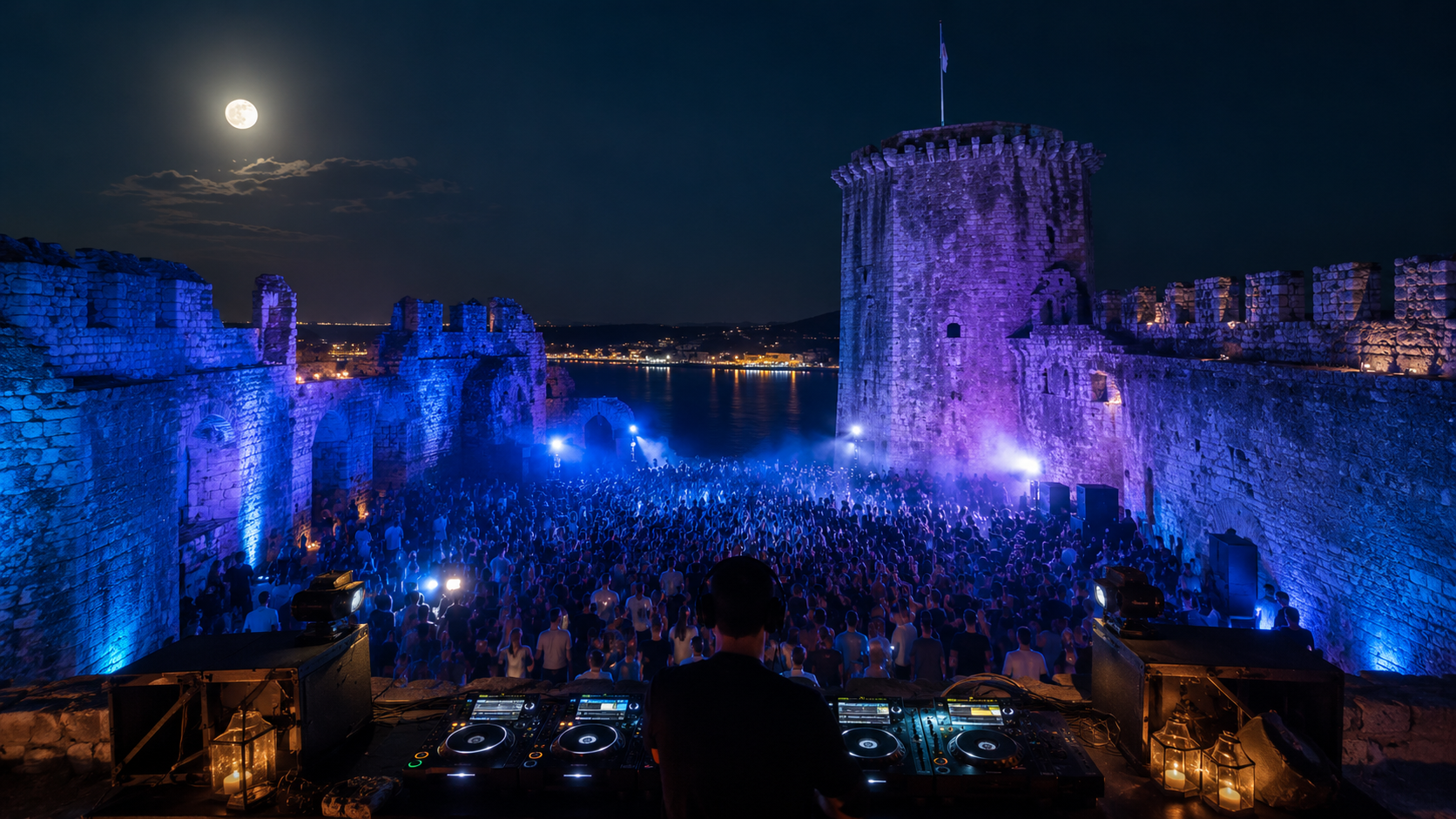
On the western edge of Trogir’s old town, the stone walls of Kamerlengo Fortress face the Adriatic as they have for centuries. In daylight it belongs to the architectural fabric of one of Croatia’s most carefully preserved historic cities. At night, for one summer weekend, it has another function: a compact, open-air techno room with medieval walls instead of black concrete.
That tension between place and sound is the reason Moondance Festival has always felt different from the larger destination festivals scattered along the Croatian coast. It started small in 2013, with a one-night licence, roughly 700 visitors and Jeff Mills at the top of the bill. Thirteen editions later, its history reads like a compressed map of underground techno: Detroit lineage, Birmingham pressure, Berlin connections, Croatian and Balkan selectors, live hardware sets, boat parties, workshops and a persistent refusal to turn the fortress into a generic EDM stage.
A techno festival born from Dalmatian club culture
Moondance was founded in 2013 by Croatian DJ and promoter Pero FullHouse, also known as Skeptik. By then he had spent more than two decades DJing and organising club nights, mainly along the Dalmatian coast. The initial idea was deliberately modest: an intimate festival that behaved more like a serious club night than a large-scale summer spectacle.
Kamerlengo gave that idea a physical identity. The first edition was granted a one-night licence and brought Jeff Mills to Trogir as headliner. The festival’s own archive records around 700 people at that inaugural event. It is difficult to imagine a more concise statement of intent: one of techno’s defining artists playing inside a fifteenth-century fortress on the Adriatic, with none of the scale associated with Croatia’s bigger festival brands.
The booking policy expanded quickly without abandoning that axis. The 2013 programme also included Oxia, Mr C, Alexander Kowalski and Dosem. A year later came Agoria, Vince Watson, Anthony Rother, Ben Sims and Technasia. In 2015, Dave Clarke, Octave One and Saytek appeared. Jeff Mills returned in 2016, alongside Josh Wink, DJ Bone and Deetron under their Sorrytellers project. By 2017 the bill moved through Oscar Mulero, Robert Hood, DJ Deep, Psyk, Ben Sims and The Analogue Cops.
That sequence matters because it shows what Moondance was building before the word “boutique” became a routine piece of festival marketing. The lineups were not constructed around crossover names. They joined established techno figures with Croatian and regional artists including Petar Dundov, Insolate, DJ Jock, Edy C, Tome R and Forest People, placing local scenes in the same room as international guests rather than treating them as decorative warm-up material.
Kamerlengo is not a neutral backdrop
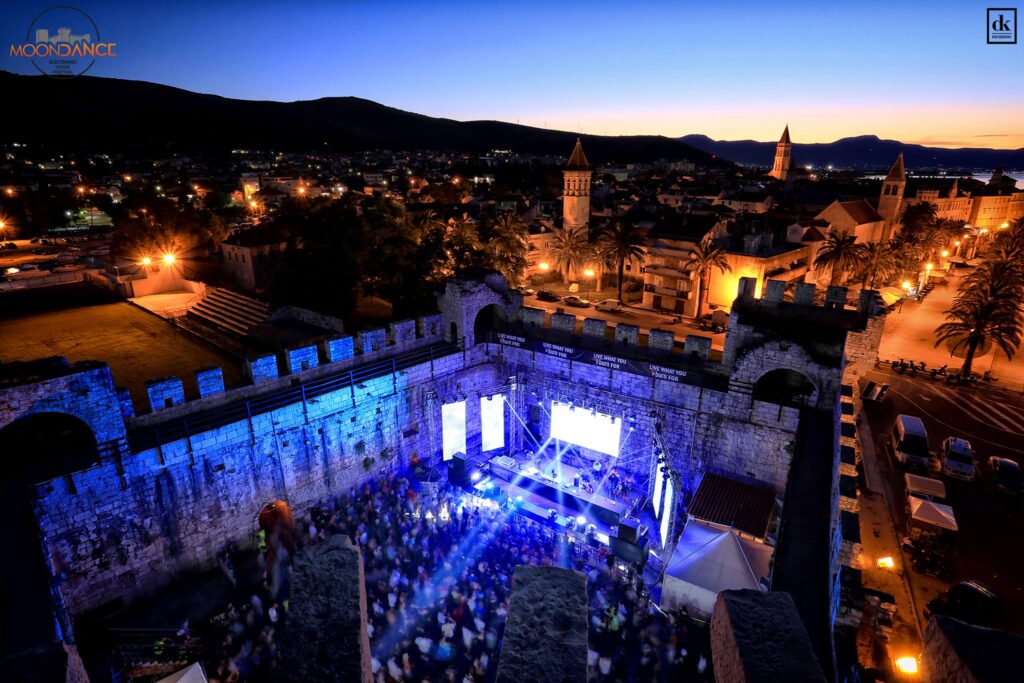
The venue does a considerable amount of the festival’s work. Kamerlengo Fortress was built between 1420 and 1437 during the Venetian period, incorporating earlier defensive structures on Trogir’s south-western edge. Its irregular trapezoid shape, towers and heavy stone enclosure were designed for defence, not acoustics or dancing.
That is precisely why the setting works. The courtyard creates the enclosure of a club while keeping the sky completely open. The walls compress the visual field, lighting catches rough limestone instead of truss and fabric, and the sea sits only metres away. There is no need to manufacture an atmosphere that is already present in the architecture.
The wider city gives the festival an unusual context too. The Historic City of Trogir has been on UNESCO’s World Heritage List since 1997. Its street plan retains Hellenistic roots, while Romanesque, Gothic, Renaissance and Baroque layers remain unusually intact. UNESCO specifically identifies the Camerlengo fortification among the surviving elements of the city’s defensive history.
In club terms, the contradiction is productive. Techno has long thrived in repurposed industrial or infrastructural spaces: warehouses, power stations, bunkers, railway arches. Moondance applies a similar instinct to a monument rather than an abandoned utility. The architecture is older, but the principle is familiar: let the space shape the night instead of hiding it behind production.
From one night to a wider festival ecosystem
As the event grew, Moondance stretched beyond the fortress without losing it as the centre of gravity. The organisers added warm-up sessions, afterparties, boat parties, workshops and, in some editions, multiple stages. Their own festival history says attendance reached up to 9,000 across the 2018 edition and associated programme.
The expansion also produced some distinctive partnerships. A recurring relationship with Tresor brought Berlin artists and residents into Trogir over several years, reinforcing a link that made sense musically rather than simply as branding. The festival has repeatedly booked artists tied to the harder, machine-led history of European techno, from The Analogue Cops and Handmade to Bloody Mary and later Berlin-connected acts.
The tenth edition in 2023 made that long view especially clear. One night was built around Ben Sims and regional artists; another carried the HUSH! Women in Techno concept with Adriana Lopez, Insolate, Madalba and others; the closing fortress programme was linked to Tresor, with Bloody Mary and The Analogue Cops among the names. Boat parties, production workshops and an afterparty expanded the weekend, but the musical language remained recognisably Moondance.
That balance between international history and regional continuity is one of the festival’s strongest traits. Croatia has long been a major summer destination for electronic music, but the country’s festival map is broad: house, bass, commercial dance and large-scale destination events all compete for attention. Moondance has occupied a narrower lane, closer to the people who still care whether a night leans Detroit, Birmingham, Berlin, Spanish hypnotic techno or Croatian hardware culture.
Awards, setbacks and a smaller scale after the peak years
Recognition arrived relatively early. Moondance won Croatia’s Ambasador award for best domestic festival in 2016, 2017 and 2018, while the 2018 edition also received the boutique-festival award. Its related label, Moondance Records, was named best new label in 2017.
The festival’s trajectory was not a straight line. The pandemic years forced a reduced format, reflected in the “LTD” editions of 2020 and 2021. Rather than abandoning the project, the organisers worked with more compact lineups and a strong regional and Berlin-facing selection. By 2022 the broader programme had returned, including multiple events, workshops and more than twenty artists.
Recent editions have also shown a deliberate interest in feeding artists back into the local circuit. In 2025, the festival launched Moondance.Warp, a DJ competition and development platform designed to give less-established Croatian and regional DJs a route from local collectives and clubs onto a festival lineup. Six competition-selected DJs appeared that year alongside Dave Clarke, Marco Bailey, Cristian Varela and established local names.
That initiative makes sense for an event that has always relied on the health of the surrounding scene. Festivals can import headliners indefinitely; they cannot manufacture a local culture from nothing. Moondance’s longevity has depended partly on the fact that Trogir, Split, Zagreb, Osijek, Rijeka, the wider Balkans and neighbouring scenes keep producing DJs who understand the same musical language.
The 13th edition kept the focus tight
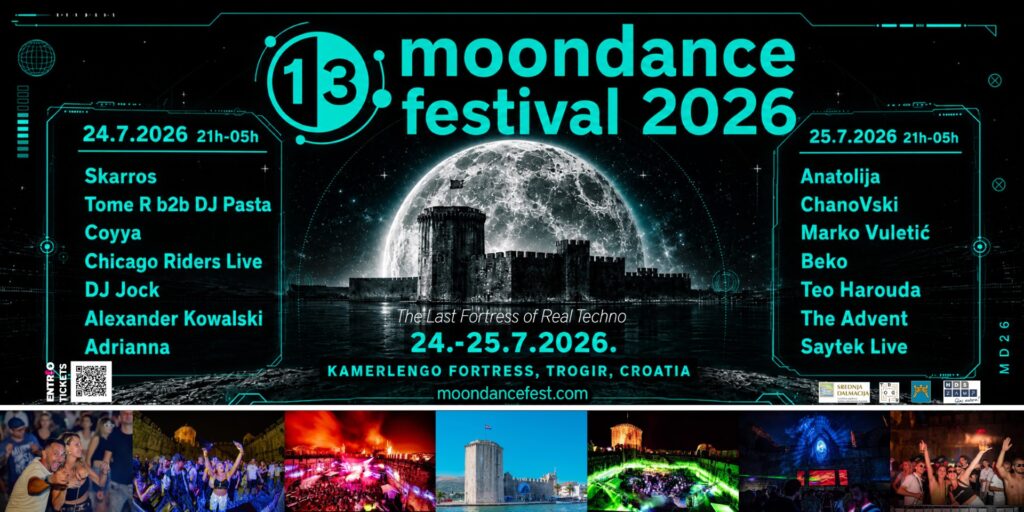
The most recent chapter arrived on 24 and 25 July 2026, when Moondance returned to Kamerlengo for its thirteenth edition. The programme ran from 21:00 until 05:00 on both nights, with a lineup that again mixed long-established European names, live performance and regional artists.
Friday moved from Skarros, Tome R b2b DJ Pasta and Coyya through Chicago Riders Live and DJ Jock before Alexander Kowalski and Adrianna closed the late stretch. Saturday featured Anatolija, ChanoVski, Marko Vuletić, Beko and Teo Harouda, followed by The Advent and Saytek Live.
Those headliners connect several threads in the festival’s history. Kowalski had already appeared at the first Moondance in 2013. Saytek’s hardware-driven live approach has been part of the festival’s vocabulary for years. The Advent brings a direct line back to the uncompromising European techno of the 1990s. Around them, Croatian and regional artists kept the programme from becoming a museum piece.
The 2026 edition was also noticeably compact compared with the festival’s more sprawling years. Two fortress nights, no need for a giant site map, no attempt to inflate the concept into a multi-genre resort. That reduction suits Moondance. The festival is strongest when the idea is simple enough to explain in one sentence: proper techno in an extraordinary room.
Why Moondance
After thirteen editions, Moondance has accumulated enough history to be discussed without resorting to nostalgia. The interesting part is not that Jeff Mills played there once, or that the fortress looks good in photographs. It is that the event has maintained a recognisable musical identity while the Croatian festival economy around it has changed dramatically.
Its scale is part of that identity. Kamerlengo limits the instinct to keep growing. The stone walls impose a boundary, and the festival has repeatedly returned to the intimacy that inspired its founder in the first place. In a season where many electronic events sell destination, spectacle and lifestyle before music, Moondance’s appeal is still unusually legible from the lineup itself.
There is also a useful piece of club history embedded in the project. Moondance connects Detroit and European techno traditions with a Dalmatian setting that has its own long-running network of promoters, DJs and dancers. It treats Croatia as a scene, not merely a coastline onto which international festivals are dropped for the summer.
Kamerlengo will always do some of the romantic work: moonlight, old stone, sea air and the strange physical pleasure of hearing kick drums hit inside a fortress built six centuries earlier. But the festival has lasted because the programming gives that setting a reason to exist after the photograph is taken. The walls are memorable. The real continuity is in the sound.

THE CONVERSATION
Opinions, context and replies from the AT-DJ community.